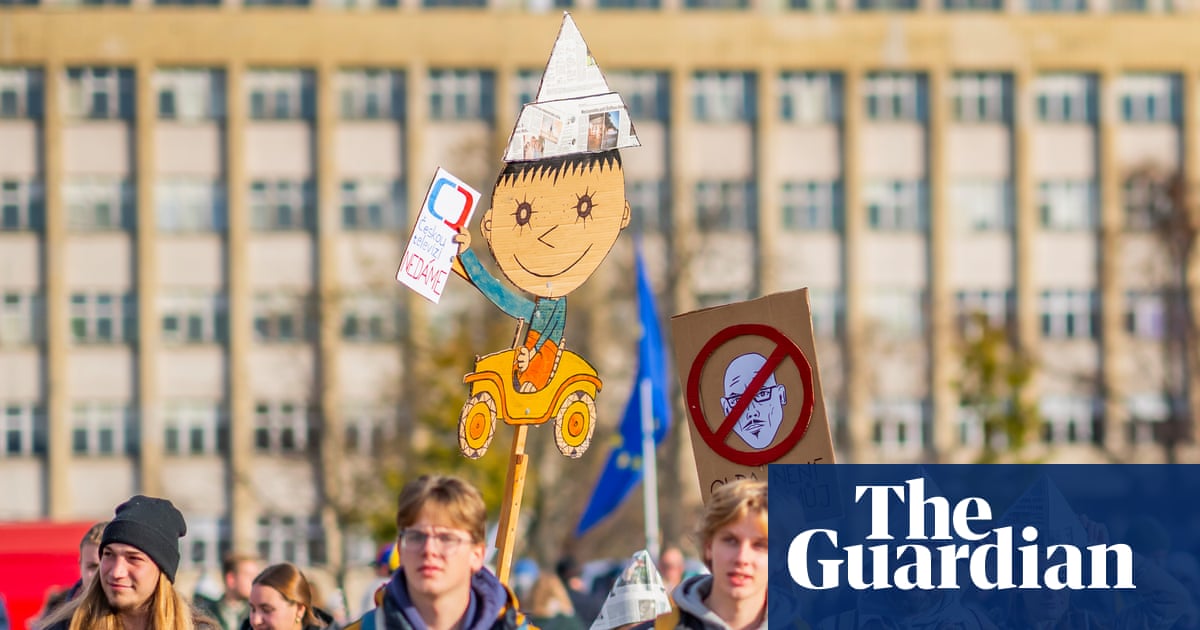
The Czech children’s television character Večerníček, who has wished children goodnight for 60 years, has become a symbol of opposition to government plans for public broadcasting. Demonstrators at rallies in support of Czech public broadcasters have worn small hats folded from newspapers, a reference to the character’s distinctive headwear.
Večerníček appears on Czech Television every evening at 6.45pm. He wishes children dobrý večer (good evening), climbs a staircase in the sky and tosses newspapers from under his arm. His name is the diminutive of večerník, the word for the once-familiar evening newspaper. The programme began in 1965 and features a short animated bedtime story.
The character has been part of a nightly ritual for Czech families, with stories featuring characters including Rumcajs the highwayman, Maxipes Fík the enormous dog and Krtek the Little Mole. The programme ends with Večerníček saying dobrou noc (goodnight).
The voice behind those greetings is Michal Citavý, 68, who runs a travel business with his wife, Zuzana, and divides his time between south-east Asia, Europe and South Africa. He recorded the phrases when he was six, in 1964, after a film company arranged for him to come to a television studio near Prague.
“The guys from the film company needed a child to say ‘Dobrý večer, dobrou noc’. I think I was probably the only one who was around during the holidays and relatively close to the city,” Citavý said. He recalled repeating the words at the studio before being driven back to his grandparents’ weekend house.
Citavý said he had heard about the demonstrations from his daughters but had not followed them closely. Hundreds of thousands of people have turned out in Prague since late October to oppose government plans to abolish licence fees for public television and radio and fund them instead from the state budget. Critics fear the change will diminish media independence.
Večerníček has endured the Soviet-led invasion, the Velvet Revolution and the dissolution of Czechoslovakia. Its use by opponents of the government’s plans for Czech Television and Czech Radio has particular resonance because the character represents a shared cultural experience rather than an explicitly political cause.
Citavý said he used to dislike being known as the voice of Večerníček, but no longer minds. His wife enjoys telling people, he said. “Though when I was away on business it was always nice knowing I could still say goodnight to them every evening.”