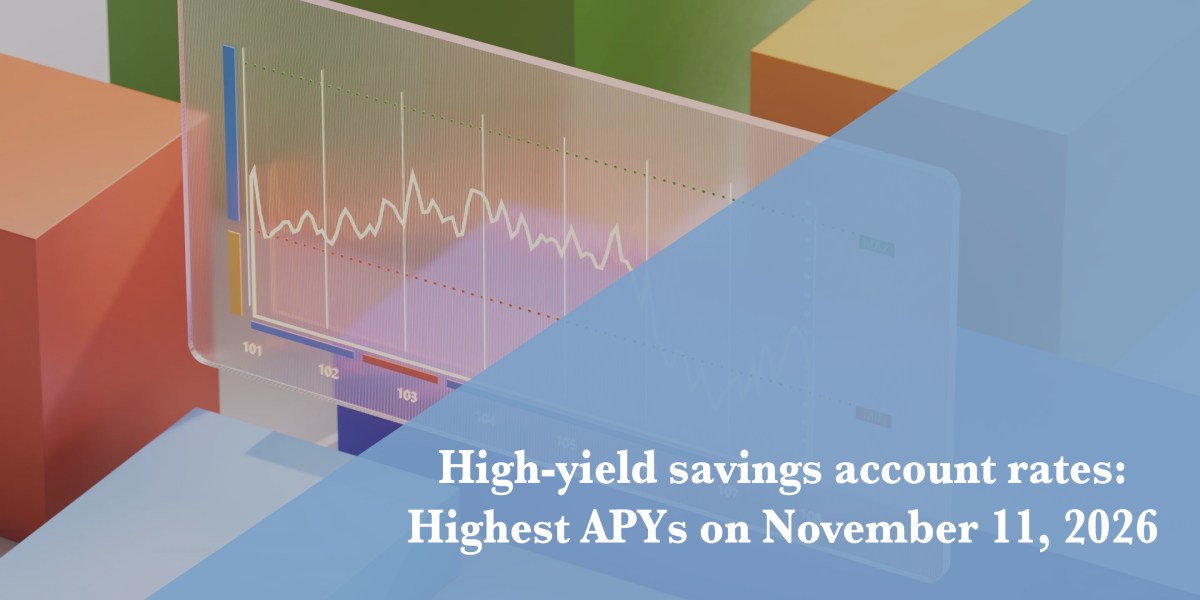
You’re looking at up to 4.70% APY on top high-yield savings accounts as of Nov. 11, 2026. To put that in perspective, that’s more than 10x higher than the FDIC-reported national average of 0.38%. For anyone trying to get real returns on their savings, the difference is substantial.
Whatever brought you here—whether it’s building an emergency fund saving for a major purchase like travel, putting away funds to invest in precious metals, or planning for retirement—keeping your money in a high-yield savings account is smart. You get solid returns without too much complexity or the risks associated with stock market investments and the like.
Fortune has partnered with the financial industry consultants at Curinos to give you an accurate look at the highest savings account rates on the market. Read on to see our full list of HYSAs and find the one that’s right for your needs.
We work with Curinos, which has a track record of more than thirty years analyzing financial services data, to bring you current rates on savings accounts and CDs from a long list of financial institutions. This daily reporting gives us the foundation to create a selection that actually helps you pick the right account for your situation.
While the average savings account rate has increased from the lows seen from 2020 to 2022, it’s still far below the APYs available on the most generous high-yield savings accounts on our list.
A quick terminology note: There’s no official account type called a “high-yield savings account.” What we’re really talking about is banks and credit unions that happen to offer rates significantly higher than average. It’s just a label we use to make things clearer.
Most of the divide between traditional and high-yield accounts comes down to operations. Traditional banks run branch networks and offer everything under the sun—loans, checking, credit cards, you name it. High-yield providers are usually online-only, keep their offerings lean, and have no physical locations to maintain. That operational simplicity translates to better rates for you.
Learn more about different types of savings accounts.
If you’re willing to handle your banking online, switching to a high-yield account can meaningfully increase what you earn. Depending on your deposit and APY, you could be looking at hundreds—or more—in extra interest annually compared to a standard savings account.
Let’s assume a hypothetical where you’ve got five grand sitting in savings a full year, and the APY doesn’t budge. The interest you’d earn with a 5.00% APY is dramatically different from what you’d earn if the account’s APY was a mere 0.40%. See the estimates below:
It’s a surprisingly painless change that can have a real impact on your bottom line.
Focus on these things when you’re choosing a HYSA:
Note that any interest you earn will be taxable.
They could. Banks often adjust their rates based on what the Federal Reserve does. Given that the Fed cut rates several times in late 2025—a win for borrowers, a challenge for savers—it’s reasonable to expect that some savings account rates could head downward accordingly, if banks expect another cut in 2026.
That said, there’s just one Fed meeting left this year, and observers don’t anticipate that the central bank will reduce its benchmark rate.
As long as your account is FDIC- or NCUA-insured, you should be protected up to a $250,000 maximum per financial institution. Also, understand that your savings won’t fluctuate like stock…