Originally published by PBS World. By Nick Schifrin.
President Trump landed in southern China after signing a trade deal and pledging increased defense cooperation with the Philippines. On Thursday, Trump will hold a historic summit with the Chinese and Russian presidents on the sidelines of a meeting of Asia-Pacific countries in Shenzhen, China. Nick Schifrin reports. Geoff Bennett: President Trump landed in Southern China today after signing a trade deal and pledging increased defense cooperation with the Philippines.
Amna Nawaz: Tomorrow, Mr. Trump will hold a historic summit with the Chinese and Russian presidents on the sidelines of a meeting of Asia-Pacific countries in Shenzhen, China. And that is where Nick Schifrin joins us from tonight -- Nick. Nick Schifrin: Amna, those milestone meetings begin in just a few hours, just a few miles from here, the site of the APEC summit.
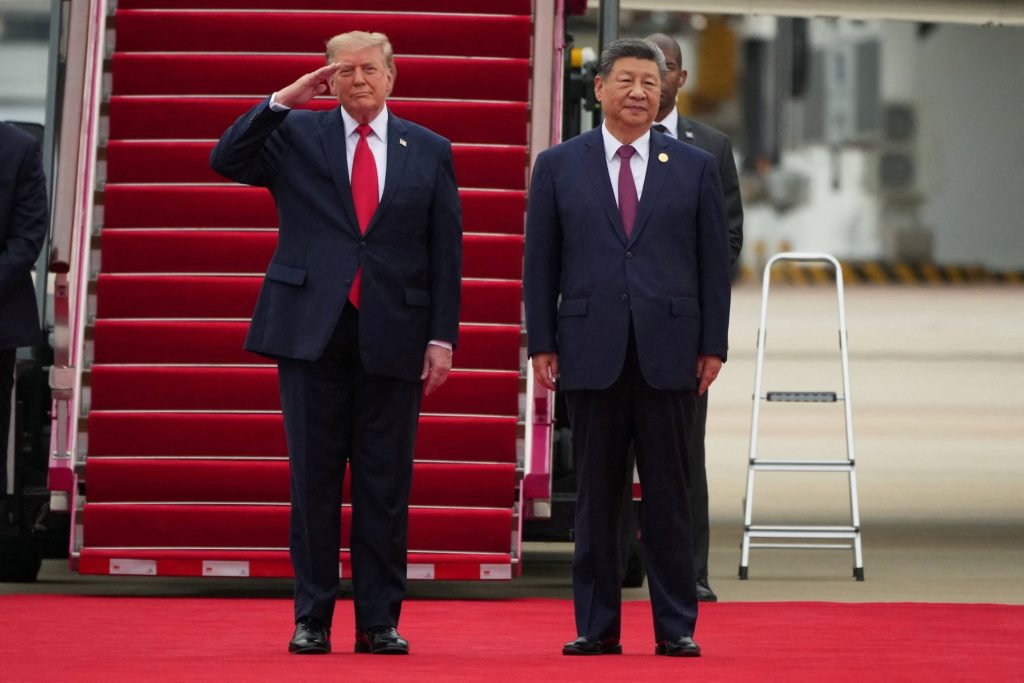
There's no official agenda, but the topics will include war and peace, Iran and Ukraine, trade, and nuclear weapons. Beijing says it could have -- quote -- "groundbreaking significance," as President Trump's trip here began with an unusual show of respect. In his 14 years in power, China's most powerful leader since Mao has never done what he did today, personally greet a foreign leader at the airport.
But Xi Jinping and President Trump today leaned in to their promise to stabilize the U.S.-China relationship. And next to China's communist leader, Russian President Vladimir Putin joined hands with the leader of the free world ahead of their trilateral tomorrow, the first ever formal meeting held among the leaders of China, Russia, and the United States.
President Donald Trump: So we're going to talk about denuclearization, tough subject. Nick Schifrin: President Trump wants to talk about reducing nuclear weapons. Man: China has joined the United States, Russia, France, and Britain in the exclusive nuclear club. Nick Schifrin: For years following China's 1964 nuclear test, Beijing limited its stockpile to around 300 weapons.
But, today, Beijing tests nuclear-capable missiles and its nuclear arsenal is the fastest growing in the world. The Pentagon says, by 2030, Beijing will have more than 1,000 nuclear warheads. But that's still a fraction of the U.S. and Russia's. And Xi has long refused to discuss arms control until achieving parity. But trilateral arms control has long been a Trump priority.
President Donald Trump: China is, frankly -- also, we discussed the possibility of a three-way deal, instead of a two-way deal. Nick Schifrin: And ahead of the summit, a senior U.S. official admonished: "We do think it's time for China to step up to the adult table and have adult conversations about adult things. They can't just take their ball and go home." China's Foreign Ministry this week suggested the ball is in their court, and said the trilateral will have -- quote -- "groundbreaking significance." Why would Xi Jinping, why does Beijing want this trilateral meeting here?
Li Cheng: Well, first of all, it makes China look good. China is the country to host these two major powers. Nick Schifrin: In Shenzhen, I sat down with Hong Kong University Professor Li Cheng, who founded the Center on Contemporary China and the World. He says Beijing sees the meeting in the context of convening the region's leaders, not as a sequel to the 1945 Yalta summit, when Roosevelt, Churchill, and Stalin divided up Germany and Europe.
Li Cheng: China did not see Russia as, like, a three kingdom. It's a multipolar world. And the multilateralism is the emphasis. Nick Schifrin: For Putin, the meeting will allow him to play global statesman after meeting Xi today. Xi Jinping, Chinese President (through interpreter): China-Russia relations have remained as solid as a mountain, undaunted by wind and rain, providing greater stability to an increasingly complex world.
Nick Schifrin: Of course, the complexity has in part been created by Putin himself. The war in Ukraine will be a topic, despite Ukrainian President Volodymyr Zelenskyy's fears, as he told Amna earlier this month. Volodymyr Zelenskyy, Ukrainian President: But I hope that these big guys will not -- will not divide the world and, of course, our country.
Nick Schifrin: The other war on the agenda, Iran, where today the U.S. targeted an Iranian missile site. What about Iran? Do you think that Beijing is willing to help? Li Cheng: I think the answer is yes. China wanted the strait open. China wanted to -- Iran to have a -- to not develop a nuclear weapon. But, most importantly, I help you in this area, but, as a transactional leader, you should also understand China's core interests.
So, that expands China's position. Nick Schifrin: At the top of China's core interests, Taiwan, trade and technology, and President Xi and Trump tomorrow will have their third bilateral this year after the U.S. this week increased restrictions to prevent Beijing from skirting us laws to access high-end chips. Beijing has countered those export controls with their own, restricting the sale of rare earth magnets, essential for everything from electric vehicles to American fighter jets.
Does Beijing feel it has leverage right now? Li Cheng: China does have leverage. And rare earth is the one of the things. This certainly makes Chinese leadership more confident that they want to demand mutual respect. Nick Schifrin: In this city of 18 million, a former fishing village whose skyline today is crammed with cranes and Xi Jinping once called a miracle of world development, it might seem natural for the government to come across as confident.
But consumer spending is down, real estate is slumping, and the middle class faces economic headwinds. Jiangyuan Luo: Most people living are in really hard situations. Their salaries get less, and their workloads get more haves. Nick Schifrin: Jiangyuan Luo recently lost his job selling to overseas customers. Jiangyuan Luo: We should have cooperation, instead of conflict.
Yes, people need cooperation. Otherwise, this is a lose-lose situation. Nick Schifrin: Is there a divide between Chinese government confidence and the Chinese people's perception? Li Cheng: Private sector is not doing so well at the moment. That create a lot of anxiety. Nick Schifrin: But for the world, Xi Jinping presents himself as a source of stability, and he invited world leaders to this gleaming city for meetings that he hopes shape the world in China's image.
For the "PBS News Hour," I'm Nick Schifrin.