Critics are questioning President Donald Trump’s support for Jensen Huang’s possible return as Nvidia CEO, amid unresolved allegations involving Chinese espionage, chip exports and potential conflicts of interest. Huang said Tuesday he would be “honored” to return, but Nvidia’s board said reinstatement is not under consideration while an internal investigation into US spying claims continues.
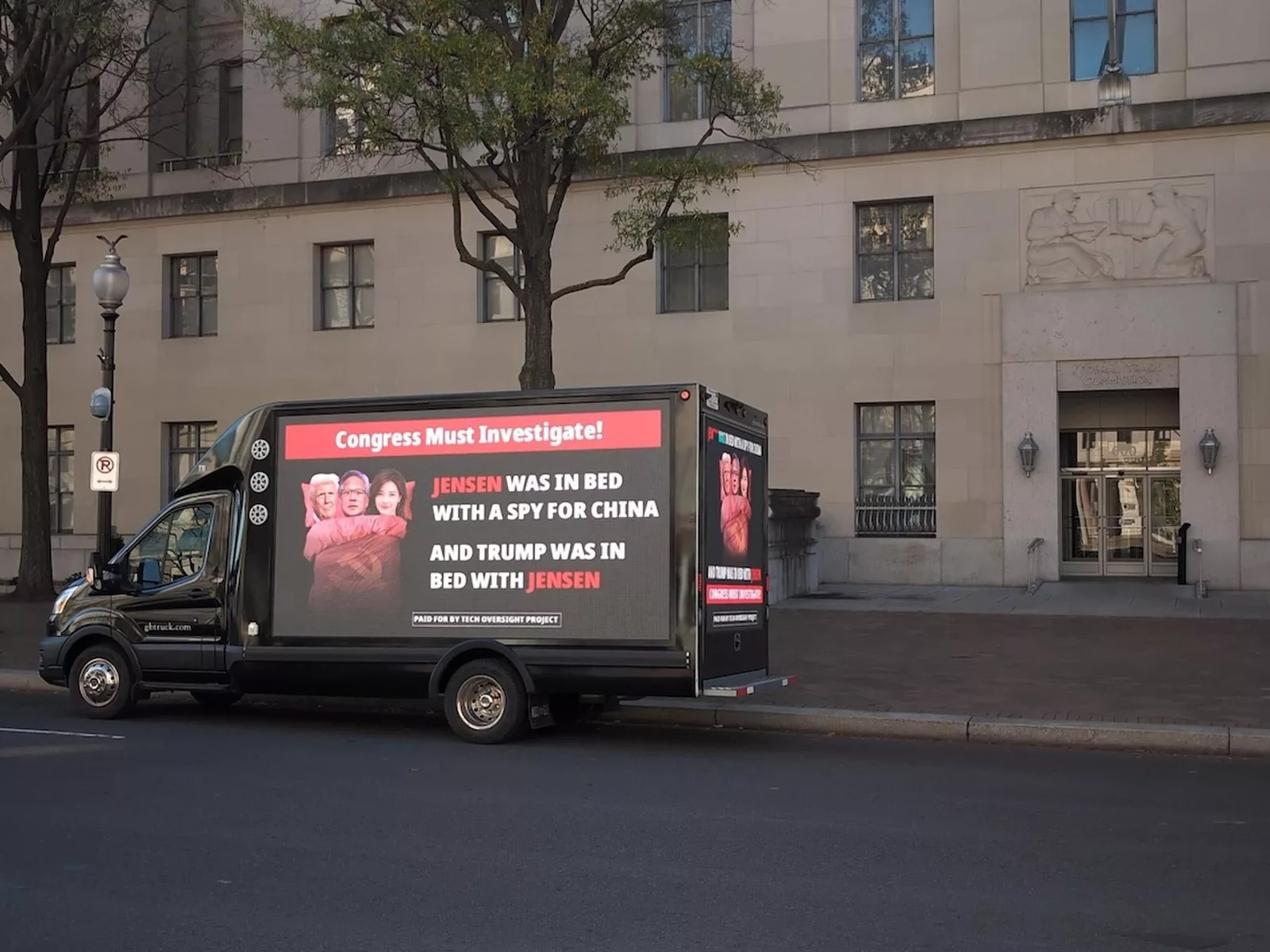
On Monday, trucks carrying billboards circulated in Washington, DC, calling on Congress to investigate the Trump administration’s ties to Huang. The Tech Oversight Project (TOP), a nonprofit that says it is “dedicated to reining in Big Tech,” created the billboards. One read: “Jensen was in bed with a spy from China. Trump was in bed with Jensen.”
Huang said he came to the United States 53 years ago and called becoming a citizen one of the greatest gifts and proudest moments of his life. “Nvidia has been my life’s work,” he said, adding: “I love our country, and I love Nvidia.”
CNN reported that Trump may have learned as early as this spring that Huang was potentially a target of Chinese espionage. Trump recently said he did not know Huang had potentially been exposed to a Chinese spy as he became part of the president’s inner circle, CNN reported. The outlet said questions remain about whether the White House responded with “sufficient urgency” or why Trump kept Huang close if he knew of the risk.
Trump invited Huang to sit at the head table during a state dinner with China’s president Xi Jinping and last month awarded him the National Medal of Science, the nation’s highest scientific honor, for his AI achievements. “Not only has he continued to do nothing, he’s invited that very CEO into the White House and on state visits to China with him,” TOP founder and CEO Sacha Haworth told Ars. “And the question we all have to ask is ‘why on Earth would he do that?’”
Questions about what Trump and Nvidia knew, and when, are drawing attention from some Republicans and top Democrats who plan to investigate the matter when they assume control of key congressional committees next year. Andrew Yoon, head of research at the nonprofit CivAI, told Ars that Huang did not need to be compromised by China to have endangered the US. Prioritizing profits over national security alone was “pretty concerning,” he said.
Yoon said Huang had been “at the absolute forefront of lobbying to be able to sell chips to China” and had used his relationships with government officials, especially Trump, to sell as many Nvidia chips there as possible. Yoon added that, if permitted, Huang would likely sell Blackwell chips to China. He said evidence suggests some Chinese AI models have been trained on Blackwell chips, and described Nvidia chips as “indispensable” to China’s frontier AI goals. National security experts fear access to high-end chips could help China advance military AI or gain economic ground.
The White House is not commenting on Trump’s relationship with Huang. Sen. Richard Blumenthal (D–Conn.) has accused the administration of “corruption” and asked the White House to “preserve all communications” between Trump and Huang, The Wall Street Journal reported.
Lawmakers are also seeking information about what Trump knew of the relationship between Huang and Alice Huang, the former Megaspeed CEO whom Huang admitted to having an affair with. They want details on “the administration’s failure to stop artificial-intelligence chips from going to China” and Nvidia’s reportedly $25 million donation to the White House ballroom, the Journal reported.
“It is not just an intelligence issue; it’s also a potential corruption issue,” Blumenthal said. He called for “a really penetrating, comprehensive investigation of all the possible compromises of our intelligence that may have occurred” and of Trump’s close ties to Nvidia’s chief executive.
Trump has bought “millions of dollars worth of Nvidia shares in his personal brokerage accounts since returning to office in 2025,” the Journal reported. The White House says the president has no role in managing his stock portfolio.
TOP said other officials advising Trump on AI also benefited from easing export restrictions. In a report issued Tuesday, the group outlined potential conflicts of interest involving former White House AI Czar David Sacks and Commerce Secretary Howard Lutnick. Haworth told Ars she was concerned they used their positions to persuade Trump to allow Nvidia to sell cutting-edge technology to China while standing to “gain astronomical amounts of money.”
Haworth said public anger over Huang did not explain the situation on its own. If “Nvidia was knowingly doing business with companies tied to illegal chip sales and smuggling with China,” she said, “the Trump administration was asleep at the wheel.” She also accused Sacks and Lutnick of “protecting their own fortunes rather than looking out for Americans.”
TOP cited New York Times reporting that Sacks had long supported Huang’s view that selling more Nvidia chips in China would help the US stay ahead in AI. After Sacks became Trump’s key AI adviser, Huang formed a “tight bond” with him, and “both stood to benefit” from the push to sell chips to China, TOP reported.
TOP also said Sacks opposed policies including the administration’s move to cut off China’s remote access to US-made chips through restricted Southeast Asian data centers. Citing Sacks’ alignment with Huang, the group reported that Trump decided after one meeting with the two men to allow Nvidia to sell AI chips to China that the Biden administration had previously blocked. TOP said Sacks took a part-time administration role to avoid divestment or disclosure requirements that might have revealed possible conflicts.
The group said Sacks and his firm, Craft Ventures, continued to invest substantially in AI while he advised Trump to embrace deregulation. TOP also said Sacks stood to benefit from pushing for AI in warfare and national security tools. Craft Ventures has invested in Palantir, “a Peter Thiel-founded government contractor seen as a ‘rising star’ in the US Defense Tech World and holding hundreds of millions in US government defense contracts,” TOP said.
Some administration officials have criticized Lutnick over the handling of the Nvidia spying investigation and Trump’s continued closeness to Huang. TOP reported that Lutnick had publicly said he promised Huang “really easy access to the President” after joining the administration. The group said the relationship helped secure Trump’s approval for Nvidia H200 sales to China.
Before becoming Commerce secretary, Lutnick was CEO of Cantor Fitzgerald, which held $1.2 billion in Nvidia stock. TOP said Lutnick was responsible for policing exports of sensitive technology to China, while he and the company he controlled benefited from opening chip sales. After Lutnick handed the company over to his son, Cantor Fitzgerald “maintained extensive commercial ties to Nvidia,” helping arrange financing for companies in its AI business network and hosting Nvidia executives, TOP reported.
TOP said Cantor Fitzgerald reduced its Nvidia holdings by nearly 50 percent between September 2025 and March 2026, around the time Lutnick faced pressure to “crack down on Megaspeed, a Singapore-based company suspected of funneling Nvidia’s advanced artificial intelligence chips to China.” When Trump was reportedly first told of the spying allegations this spring, Cantor Fitzgerald again increased its Nvidia involvement, TOP said. The company helped finance the expansion of Nvidia partner IREN, facilitating a five-year, $3.4 billion deal between Nvidia and the Australia-based cloud computing provider.
Treasury Secretary Scott Bessent is among those criticizing Lutnick over export-control enforcement. Yoon said there could be ordinary explanations for potential financial conflicts, given Lutnick’s long business career. “Maybe a separate question is ‘should people with a long storied history in business and industry be working in government at this level?’” he said.
Haworth said the next 48 hours would be critical to determining whether Huang returns to Nvidia. She said incoming Democratic leadership should ensure investigations proceed whether or not he does. Yoon said he thought a return was unlikely soon, even though current evidence suggested “Nvidia’s actions here have been perfectly legal” and “influencing a political system for your financial interests is very much legal in the United States.”
Yoon said Nvidia’s current course seemed “untenable” and argued the AI industry could not operate solely on a profit motive while governments treated the technology as a strategic asset. If US investigations uncover crimes, Nvidia could lose some of its dominant stake in the GPU market. The Information reported Tuesday that some Nvidia customers had lost trust and were looking to Google and AMD for more stability.
Nvidia has also been accused of intervening in a Commerce investigation. Yoon said evidence supporting that allegation could be “pretty consequential.” He said Huang’s return to Nvidia soon was “pretty unlikely,” though Huang might return after a “redemption tour” in five years.