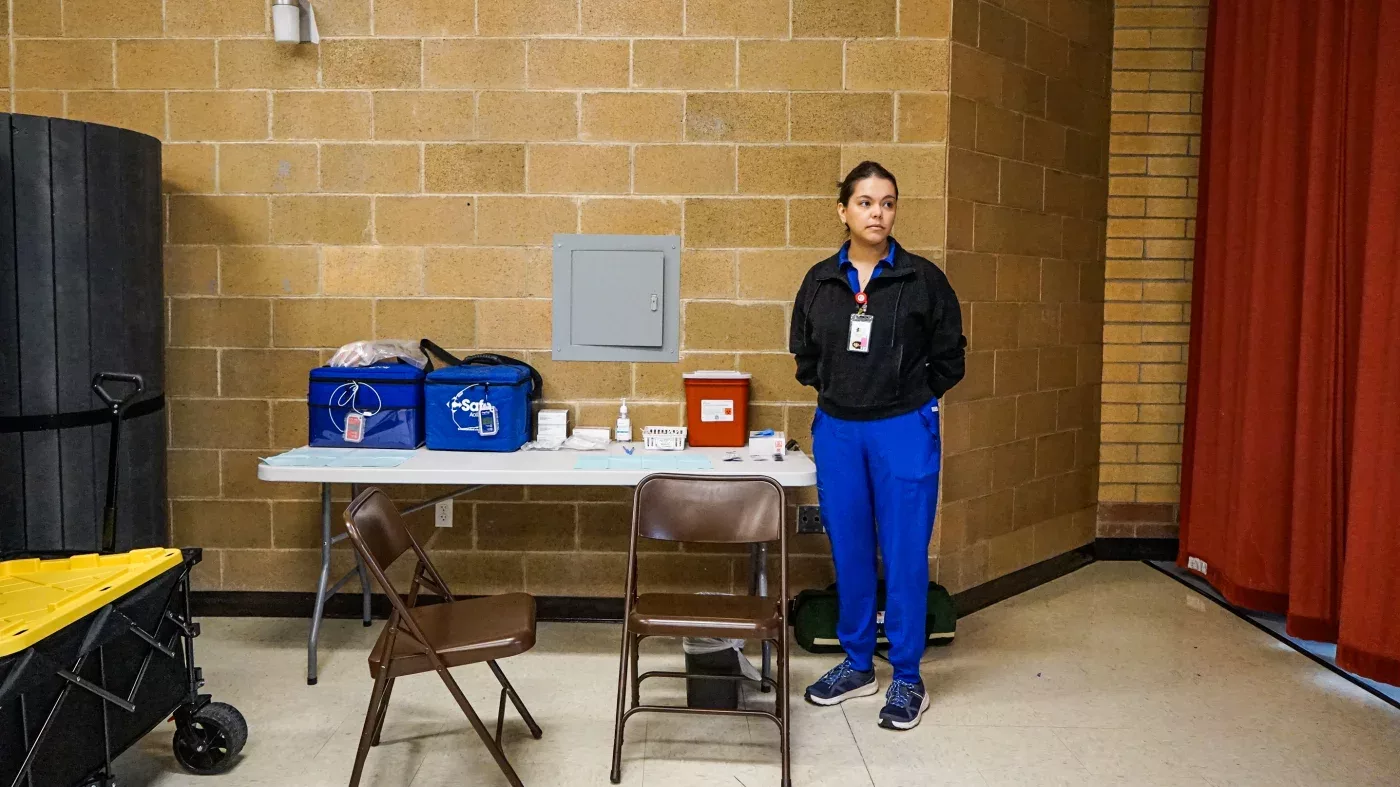
Anna Fajardo, a public health nurse, offers vaccines at a school registration event in southwestern Utah. Amy Maxmen/KFF Health News hide caption
The U.S. has lost its status as a country where measles is eliminated, a public health triumph secured a quarter century ago.
Researchers with direct knowledge of the deliberations on the country's status told KFF Health News that the Pan American Health Organization reached the conclusion this week: Measles has reestablished regular transmission in the country.
PAHO had planned a public announcement on Nov. 17.
In public health parlance, measles elimination depends on a country's sporadic outbreaks ending within a year. That's no longer happening in the United States.
"It's a very sad moment," said Anne Schuchat, an epidemiologist and a former deputy director at the Centers for Disease Control and Prevention who was not involved in PAHO's decision.
"Measles causes so much unnecessary suffering, everything from a high fever and missed work and school to long-term complications like progressive degenerative nerve disease and death," Schuchat said.
Measles outbreaks are entirely preventable: Two doses of the measles-mumps-rubella vaccine prevent about 97% of infections, so when almost everyone in a community is fully vaccinated, the virus can't spread.
In the past two years, over 830 people have been hospitalized with measles in the U.S. More than 8,000 people have been sickened in outbreaks that have cost roughly $125 million in medical care, public health response, and productivity losses, Johns Hopkins University researchers estimate.
States have reported 13 measles-associated deaths, including a 7-month-old in New York and infants in Pennsylvania and Wisconsin in recent months. Babies typically aren't vaccinated before they're a year old.
PAHO, an international group that oversees health in the Americas and works with the World Health Organization, based its assessment on two analyses: one by the CDC and another by an independent group of measles experts.
Researchers anticipated this conclusion after an outbreak in Utah surpassed the one-year mark in June.
A spokesperson for the Department of Health and Human Services, Emily Hilliard, attributed the resurgence of measles to vaccination gaps that opened years before this administration. Indeed, rates of childhood vaccination have steadily declined since the COVID pandemic started.
But many scientists also blame the Trump administration for spreading vaccine misinformation and stifling a swift, strong response to outbreaks.
For example, the administration cut millions of dollars from children's immunization programs run by state health departments and terminated funds for research on vaccine hesitancy.
After Health Secretary Robert F. Kennedy Jr. sacked CDC director Susan Monarez in August 2025, she told Congress she was fired because she would not preapprove changes to vaccine recommendations "without reviewing the evidence."
Monarez added that "we already have seen the largest measles outbreak in more than 30 years" and that, "if vaccine protections are weakened, preventable diseases will return."
Spokespeople for HHS and the White House defended the administration, and Kennedy, who led a prominent anti-vaccine organization before he took the helm at HHS. "The President and the Secretary have repeatedly encouraged measles vaccination, coordinated with states, and facilitated the deployment of vaccine doses across the country," White House spokesperson Allison Schuster wrote in an email.
For more than three decades, the federal government treated measles as a preventable tragedy, with sizable outbreaks triggering national efforts to boost vaccination and stop the virus from spreading.
That's no longer the case, said Patsy Stinchfield, executive director of the Measles Collaborative, a new initiative that educates the public about vaccines and assists health workers responding to outbreaks.
Stinchfield was a pediatric nurse at a children's hospital in Minnesota during the nation's last surge of measles before elimination, from 1989 to 1991. She recalled an entire ward devoted to children with measles and the enormous effort required to prevent the virus from spreading to kids with cancer and weakened immune systems.
Two children at the hospital died of measles. "That changed my career forever," she said.
Back then, she said, the federal government "saw the urgency." Officials held press conferences, spoke on the news about vaccines, issued clinical guidelines, and published reports in the CDC's flagship journal — the Morbidity and Mortality Weekly Report, or MMWR — that drove policies.
When data suggested that some children weren't mounting a strong response to a single dose of the measles-mumps-rubella vaccine, a CDC advisory committee recommended two doses of the shot.
When CDC analyses found that many children with measles hadn't been vaccinated due to cost, the government launched the Vaccines for Children program to make immunizations available free of charge to underinsured families.
Cases plummeted. By 2000, the CDC and PAHO determined that measles was no longer a national threat — measles transmission had been eliminated.
"Elimination" allows for occasional outbreaks, because measles is not eradicated worldwide and a small fraction of people, such as young infants, can't be protected by vaccines.
People infected abroad sparked occasional outbreaks after U.S…