The U.S. Navy announced at the Naval Submarine League conference in Arlington, Virginia, that its next-generation SSN(X) nuclear-powered attack submarine will be built as a mothership capable of launching, recovering, and controlling multiple unmanned underwater vehicles (UUVs). According to Rear Adm.
Andrew Miller, Director of the Undersea Warfare Division, the Virginia-class successor will integrate dedicated autonomous vehicle handling, recharging, and command-and-control infrastructure directly into a wider hull combining Seawolf-class speed and weapons capacity, Virginia-class acoustic stealth, and Columbia-class operational availability.
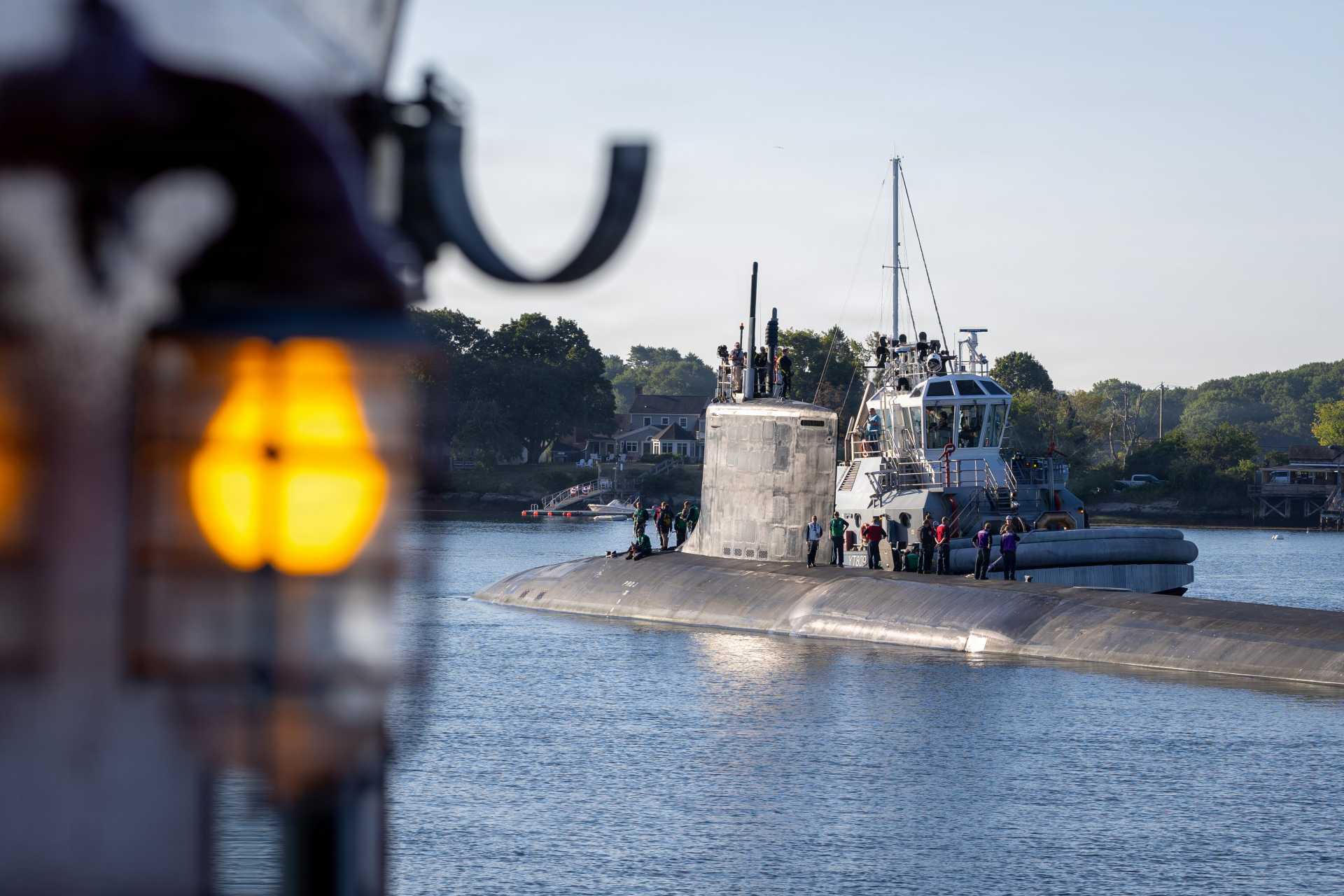
Unlike the Virginia-class, which has to retrofit existing torpedo tubes and missile launchers to handle unmanned underwater vehicles, the SSN(X) will feature a wider hull with built-in infrastructure specifically designed to launch, recover, recharge, and control underwater drones without sacrificing its weapons capacity. (Picture source: US Navy)
On November 12, 2026, USNI News reported that the U.S. Navy outlined plans for its SSN(X) nuclear-powered attack submarine to operate as a mothership capable of deploying, recovering, and controlling multiple unmanned underwater vehicles (UUVs), making autonomous underwater operations a central requirement of the Virginia-class successor.
Unlike the Virginia-class, the SSN(X) would therefore incorporate autonomous vehicles into its basic architecture, rather than adapting existing torpedo rooms and missile launchers to accommodate equipment for which they were not originally designed.
At the Naval Submarine League conference in Arlington, Virginia, Rear Adm. Andrew Miller identified five priorities for the SSN(X): higher flank and tactical control speeds, improved operational availability, increased lethality, superior stealth and survivability, and integrated command and control for robotic underwater vehicles. The U.S.
Navy completed its analysis of alternatives in November 2025, secured requirements approval in March 2026, and is seeking Milestone A authorization before the end of 2026. The first SSN(X) is planned for procurement in the early 2040s, with Congressional Budget Office (CBO) calculations assuming 10,100 tons of submerged displacement and $8.7 billion per submarine in FY2024 dollars, against the U.S.
Navy's $7.1 billion estimate.
Related topic: US Navy launches Blueye X3 tethered drone from torpedo tube for submerged submarine inspections
The SSN(X) is intended to combine the submerged speed and weapons capacity of the Seawolf-class, the acoustic characteristics and sensors of the Virginia-class, and the operational availability of the future Columbia-class, while addressing limitations in weapons stowage, electrical capacity, and maintenance accessibility.
The original Seawolf design displaces 9,138 tons submerged, measures 107.6 meters, and carries eight 660 mm torpedo tubes with capacity for 50 weapons, compared with the Virginia's four 533 mm tubes, 10.4-meter beam, and original 7,800-ton displacement.
Increasing the hull diameter to approach the Columbia-class's 13.1-meter beam would therefore provide more room for UUV handling, additional weapons, electrical equipment, and internal servicing.
At 10,100 tons, the SSN(X) would also displace 29.5% more than an original Virginia-class submarine, although its final dimensions, speed, and weapons capacity remain subject to design decisions. Greater hydrodynamic and electrical margins would support future equipment without extensive hull modifications, while reduced repair duration would increase fleet availability.
For comparison, raising operational availability from 60% to 70% across 50 U.S. submarines would increase the number available at any given time from 30 to 35, illustrating the fleet-level value of maintenance improvements. The U.S. Navy's current transition toward submarine-hosted UUVs began with medium autonomous vehicles whose launch arrangements were substantially simpler than their recovery procedures.
How the U.S. Navy is developing underwater drones that can return to submarines
By November 2022, the Unmanned Underwater Vehicle Squadron 1 had tested nine Razorback drones derived from Huntington Ingalls Industries' Remus 600 family, each weighing 600 pounds and initially requiring a dry-deck shelter and divers for recovery, limiting the submarine's ability to conduct repeated autonomous missions.
A $358 million effort involving Leidos and L3Harris also addressed related medium-UUV requirements for submarine reconnaissance and explosive ordnance disposal. For instance, in July 2026, L3Harris received a Defense Innovation Unit contract for a Torpedo Tube Launch and Recovery system using a removable sleeve inside a standard 533 mm tube, allowing an Iver4 900 to depart and return underwater.
In 2026, USS Delaware (SSN-791) became the first U.S. nuclear attack submarine to achieve operational capability with Remus 620 launch-and-recovery equipment incorporating Yellow Moray docking technology, following a related British demonstration aboard HMS Astute in 2025.
However, recovery remains the main difficulty, as the submarine must guide the returning UUV into a narrow tube while controlling its relative position, approach speed, and alignment without surfacing. The Remus 620 and Iver4 900 established different operating envelopes for submarine-supported reconnaissance and seabed surveys. Huntington Ingalls Industries' Remus 620…