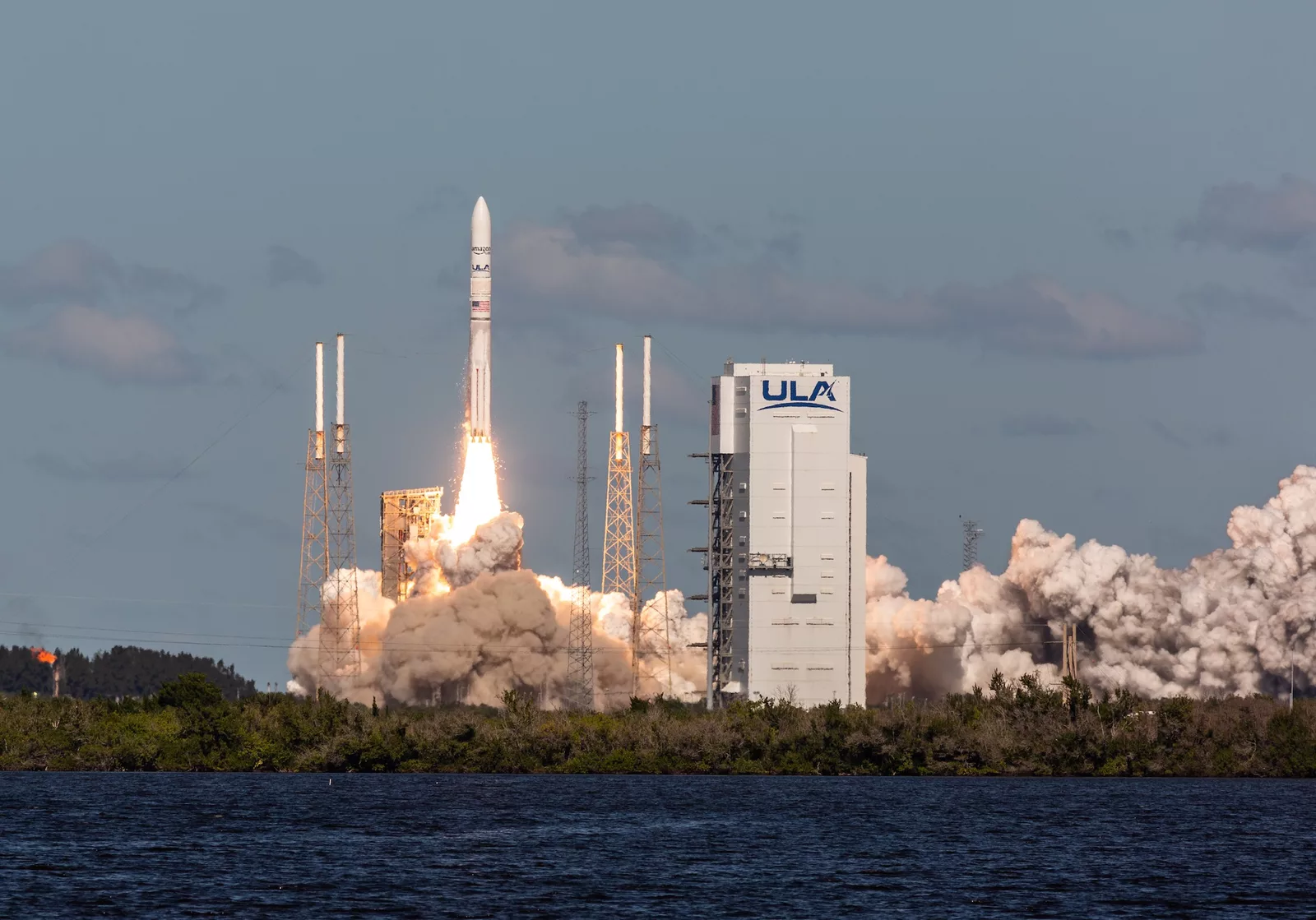
United Launch Alliance said Wednesday that inadequate fuel supply from the Vulcan rocket to its BE-4 engines caused low booster thrust during Sunday’s Leo 1 launch anomaly. The company said its review is preliminary and that work remains to determine the cause.
“ULA has completed an initial integrated review of flight data from the Leo 1 launch anomaly that occurred last Sunday,” the company said in a statement. “While work remains to determine cause, preliminary indications are that the low booster thrust was the result of inadequate fuel supply from the vehicle to the BE-4 engines, not from the performance of the engines.”
The initial findings indicate the engines themselves were not responsible for the failure. The BE-4 engines are supplied by Blue Origin and also power the company’s New Glenn rocket, which uses a similar but slightly more powerful version.
Blue Origin said Wednesday that it had worked with ULA to review flight data and support the investigation. “Together, we identified that the low booster thrust was the result of inadequate fuel supply from the vehicle to the BE-4 engines, not from the performance of the engines. ULA is a valued partner, and we look forward to Vulcan’s return to flight,” the company said.
New Glenn suffered a catastrophic failure in a ground test in May, later attributed to a main oxygen valve on one of its BE-4 engines. Blue Origin subsequently retrofitted the valve, including for Vulcan missions. ULA’s preliminary findings indicate that the retrofit was not implicated in Sunday’s accident. New Glenn’s return-to-flight mission could occur as soon as January.
The findings also indicate that Vulcan’s Centaur V upper stage did not contribute to the failure. NASA recently contracted with ULA to use Centaur V as the Space Launch System’s new upper stage for future Moon missions.
The anomaly poses challenges for ULA as it works to establish Vulcan in a US launch industry increasingly dominated by SpaceX and facing newer entrants including Blue Origin, Relativity Space, Rocket Lab and Stoke Space. Sunday’s flight was Vulcan’s fifth overall and its first outright mission failure; two earlier launches had problems involving solid rocket booster nozzles.
ULA has spent three years trying to move Vulcan into regular operations. The article said the company now faces a new issue involving propellant management and the plumbing that feeds liquid oxygen and methane to the BE-4 engines, and that the rocket will be offline for several months.