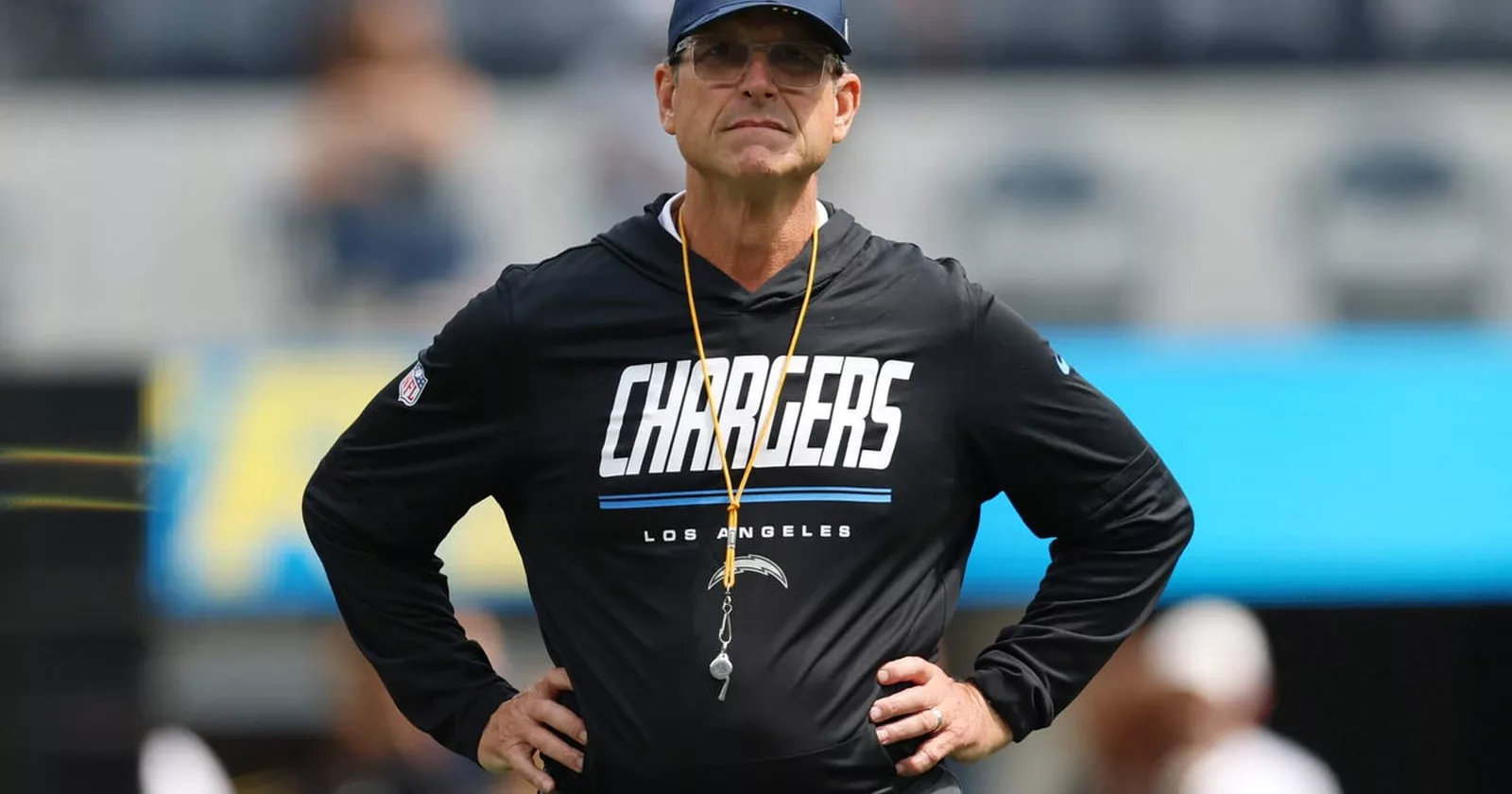
Jim Harbaugh and the Chargers were furious about the Broncos trying to renegotiate the Daiyan Henley trade. Luke Hales / Getty Images
It was all smiles at the Denver Broncos facility Wednesday. One day prior, the reigning AFC West champions had dealt a 2027 fourth-round pick and 2028 fifth-rounder to the Los Angeles Chargers for linebacker Daiyan Henley.
Henley spent nearly an hour with general manager George Paton. He toured the facilities. He created social media content for the team. The Broncos even gave him a tablet with the defensive playbook to get him started on things during their bye week.
And then he had to return the tablet. There was a hangup in the trade; in just a few hours, Henley would be returning to L.A.
I talked with sources on all sides of this and across the league, and what I gathered is that each team is certain they went about things the right way.
In the latest What I’m Hearing column, I’ll have nuggets on:
• The timing on Lamar Jackson’s thumb surgery; • Trend watch for the upcoming coaching cycle; • Why the Colts did what they did (and didn’t do); • What Thursday night showed us about the Commanders; • Jerry Jones’ 18-games claim, and why it’s hard to envision; • The NFL’s onside kick problem; • Cam Newton on Bryce Young; • Titans off the air.
(Editor’s note: For this column, team and league sources spoke on condition of anonymity to discuss a player on another team or a matter on which they are not authorized to speak publicly.)
League sources say Henley, a fourth-year linebacker, has a known knee issue but it hasn’t prevented him from playing and hasn’t required surgery. He has played in all but one game since 2024, and he has played in 87 percent of the Chargers’ defensive snaps this season.
The winless Chargers had no desire to deal players, much to the chagrin of contending teams hoping to pick over their roster. The deadline neared, and teams called on Henley. The Chargers had a fourth-round offer on the table for the linebacker, who is scheduled to be a free agent in March, but they wanted more for one of their best players.
After considerable back-and-forth, the Broncos added a 2028 fifth-round pick to get it over the finish line. The Chargers dealt their young, well-liked team captain to Denver with a hope that they could actually re-sign him come March. Being able to get two mid-round picks for Henley only to lose him for half of a lost season would be a coup for the team.
The Broncos were aware they might not be able to re-sign Henley in the offseason. Part of Denver’s calculus was that, at worst, he would play so well and be so unaffordable that Denver would get a 2028 compensatory pick after he later signed a big deal elsewhere.
But according to sources in Denver, the medical information the Broncos received did not match what they were learning in real-time after consulting with their own medical team and an independent doctor. The deadline had passed; Paton had a decision to make.
Paton could have proceeded with the agreed-upon deal. He could have outright failed Henley on the physical and sent him back to L.A. He chose option three, which was to attempt to rework the trade terms with the Chargers.
Paton pitched numerous options to the Chargers, per sources, and that is within league rules — Denver consulted with the NFL Management Council. The league would have allowed the pick compensation to change, but a league source says the NFL prohibited adding another player or trading a different player.
Those options Paton pitched included a straight fourth, which the Chargers declined. A fourth and a pick swap was also declined. A fourth and a seventh was turned down.
There is a dispute among sources about which side offered this, but I can report that there was a discussion from one side about a fourth plus a conditional fifth that would trigger if Denver signed Henley to an extension at or around the start of the 2027 league year.
The Chargers, multiple sources say, were not interested in renegotiating the deal, believing they had been truthful in their exchanges. L.A. felt as though the passed deadline was being used as leverage; the Bolts would have little recourse but to agree to lesser terms or awkwardly accept the player back.
The Broncos felt as though they did what they could to rework a deal with dignity and respect for a player who, according to a league source, they still hope to sign in free agency.
General managers and top executives I spoke with this week had varying opinions on what happened.
“You either walk away or do the deal,” says one GM. “You can’t leverage a deadline for a better deal.”
Says a top executive with another team: “This type of thing happens more often than people realize. The original club either doesn’t know the extent of an injury or downplays it. When the new club does their examination they determine there’s additional risk. They either don’t take the deal or renegotiate the deal. Not a great situation to be in on either side but it happens.
The deadline is what makes it look more nefarious.”
Chargers coach Jim Harbaugh made that point on Thursday, saying the league should look into closing a “loophole. … They told us they weren’t going to pass him if it was a fourth and a fifth, which was agreed upon, and they would not pass him for that. They would pass him for a fourth and a … fill in the blank. I don’t know what to call that.”
Harbaugh’s other point was that a physical should be pass/fail. In…