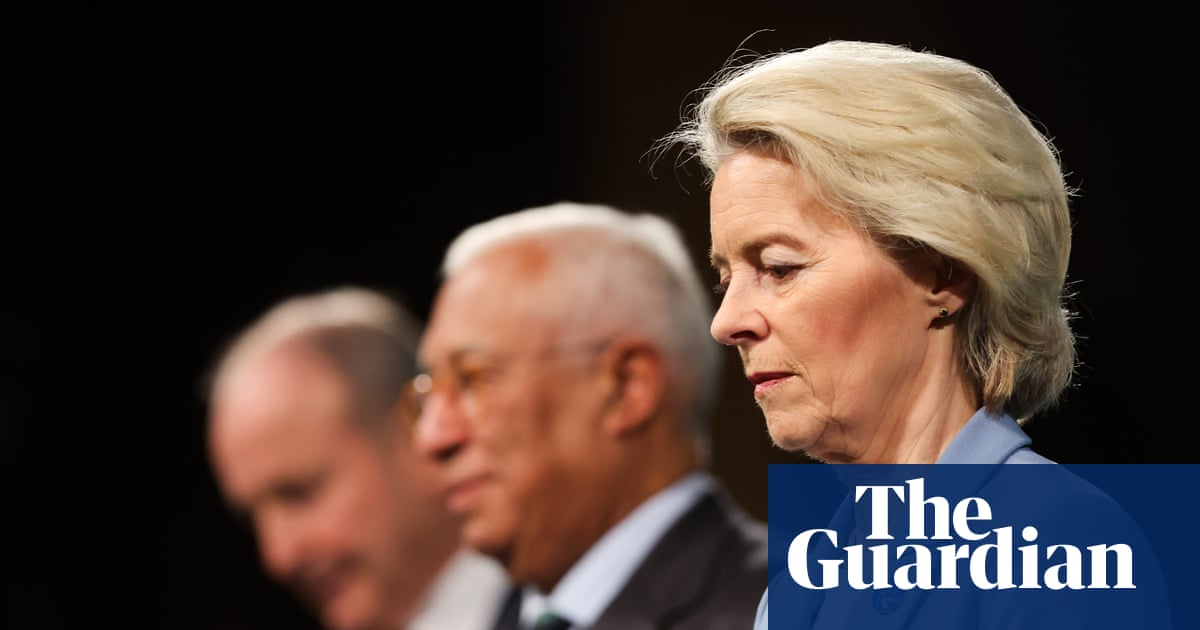
EU leaders excluded the bloc’s foreign policy chief, Kaja Kallas, from its negotiating team for Russia peace talks at a summit in Dublin, renewing questions about whether the European Union can speak with one voice on the world stage.
The talks, mediated by the US and aimed at ending Russia’s war on Ukraine, are being handled for Europe by a seven-strong team: European Council president António Costa, European Commission president Ursula von der Leyen and representatives from France, Germany, Britain, Poland and Italy, working with Nato. The team will join US negotiators Steve Witkoff and Jared Kushner.
Kallas, a former Estonian prime minister, was appointed the EU’s High Representative for Foreign Affairs and Security Policy and a European Commission vice-president in 2024. She chairs the Foreign Affairs Council, where member states agree on common foreign policy, sanctions and crisis responses, and runs the European External Action Service, the EU’s diplomatic service.
At the Dublin summit on Friday, Kallas said leaders had agreed in 2024, when it was clear there would have to be talks with Russia, “that I’mthe one who is representing Europe in foreign and security policy,” she said. But she was not included among the negotiators announced by Costa. Ukrainian president Volodymyr Zelenskyy had urged the bloc to appoint a single negotiator.
Three explanations have been raised for the decision: some western European capitals consider Kallas too fiercely anti-Russian; major EU states, particularly France and Germany, resist ceding foreign policy authority to Brussels; and leaders are increasingly taking on international matters once handled by foreign ministers.
Von der Leyen defended the decision, saying: “We decide for ourselves who will represent us, and we made that decision today,” she said. Germany’s chancellor, Friedrich Merz, described intergovernmental formats such as the E3 – France, Germany and the UK – as “a well-established format” and said “I see absolutely no problem with keeping it that way.” Spain and Lithuania criticised the approach. “Europe needs one voice,” said Lithuania’s foreign minister, Kęstutis Budrys. “We cannot speak with 27 microphones. We need one.”
Supporters of the Dublin lineup argue that the EU’s major military and financial powers should lead on security and ending the war. One EU diplomat said EU institutions “do not have sufficient political legitimacy in the eyes of voters. And this matters big time. The E5 solution is an attempt to bridge that gap.”
Critics say the decision undermines the EU’s ambitions to act as a global power. Brussels commenter Dave Keating called the approach a “European cacophony” and said Kallas’s job “is not real, and the EU doesn’t actually have a foreign policy”. Jennifer Rankin said the E5+ format could represent “the EU as it is, not the idealised union of the treaties” and “needn’t be a cacophony if everyone in the room has the same message.”
Kallas said she would focus on “substance” while leaders handled “format”. The debate over who represents the EU in the Russia talks highlights the tension between the bloc’s ambition to speak with one voice and member states’ reluctance to hand authority to Brussels.