Panama’s environment minister, Juan Carlos Navarro, said the world was “being held hostage by the petroleum mafia” as 30 countries signed up to pursue a fossil fuel treaty outside the UN process, in the final days of the Cop31 climate summit.
“We are in love with our kidnappers,” Navarro said at a press conference. “We love the petroleum guys. We can’t live without them, and they are so smart they have convinced us that they are doing this for our own good.” He added: “They torture us for our own good, they destroy our planet for our own good. They destroy nature to help us, and they demand our unrequited, endless, unlimited, boundless love. And we are so stupid that we fall for it.”
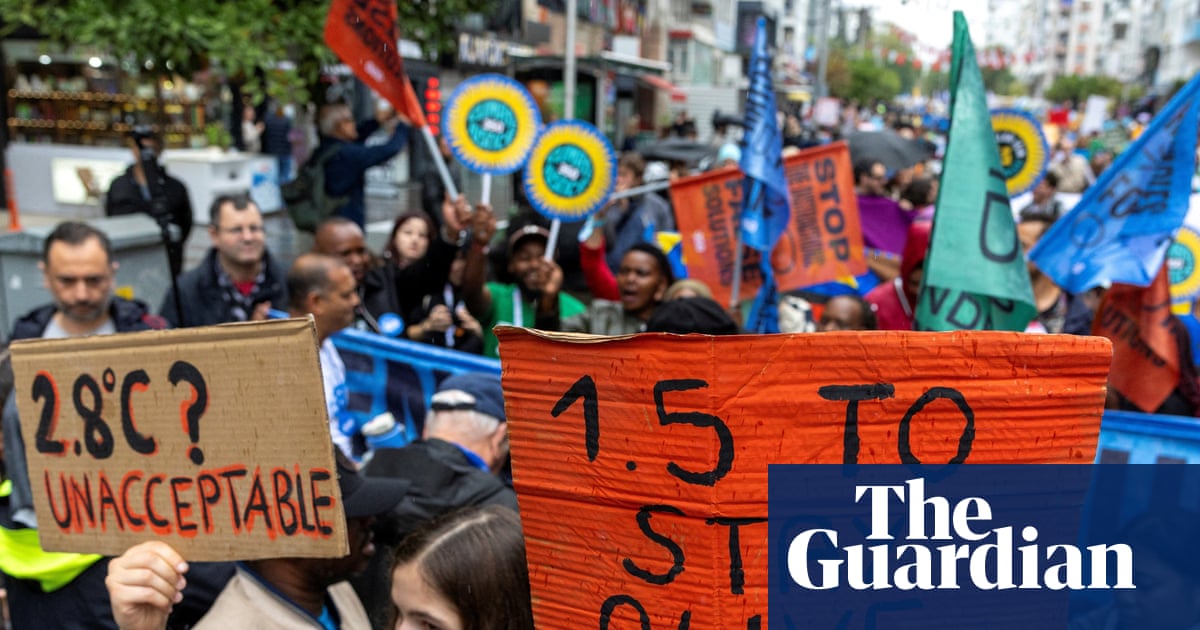
Countries have two official days of negotiations left to address issues including whether the conference should recognise the need to “transition away from fossil fuels” and how to respond to global temperatures exceeding the 1.5C heating limit targeted in the Paris agreement.
On Wednesday evening, the Australian presidency and Turkish hosts convened a “divan” meeting of ministers to work on a revised draft and seek compromises. Disagreements remain over climate finance, a “just transition” to clean-economy jobs for fossil fuel workers, and support for poor countries adapting to extreme weather.
The first draft of a “cover decision”, issued on Monday, contained 144 items. Some, including the proposed “transition away from fossil fuels”, are contentious among the nearly 200 countries attending the fortnight-long talks. A new draft is expected on Thursday morning.
Negotiators told the Guardian countries were working on compromises, although campaigners feared the final outcome would be weak. Mohamed Adow, director of the Power Shift Africa thinktank, said rich countries had pledged only $50m to a fund for developing countries to adapt to extreme weather, compared with $135m last year.
“Rich countries are offering crumbs to the adaptation fund, while blocking the negotiations that should provide the money countries need,” Adow said. “Listening to ministers praise the adaptation fund before giving next to nothing, you have to wonder how they expect it to do the work they say is so important.”
Brandon Wu, director of policy and campaigns at ActionAid USA, said there had been “massive steps backwards on adaptation finance and just transition, relative to previous Cops”. He said: “In both cases, the blocking is being led by the EU.”
Irene Vélez Torres, the former Colombian minister who convened fossil fuel phase-out talks in Santa Marta in April, raised concerns about a proposed target to generate 35% of final energy from electricity by 2035. At least 60 countries are thought to explicitly support the target, with more, including China, tacitly backing it. Vélez Torres said she wanted provisions to ensure the electricity came from renewable sources.
“I’m very scared that [the target] is not going to be explicit about clean green energy, because it may imply that they are going to lock us in future dependencies on gas and coal power. If we don’t explicitly declare that the electricity is going to be powered by green and clean energy, we may make a mistake,” she said.
Some countries are using Cop31 to pursue alternatives to the UN negotiations. Colombia has changed governments since the Santa Marta talks, but that process continues, with Tuvalu set to host its next meeting.
The Fossil Fuel Non-Proliferation Treaty Initiative, which has 30 members, is another effort to build a “coalition of the willing” to phase out fossil fuels. The Beyond Oil and Gas Alliance is also pursuing that goal.
Ethiopia, host of next year’s Cop32, is leading a group of countries seeking to become “negative emitters” by absorbing more carbon than they produce, through carbon capture or by restoring natural “carbon sinks” such as wetlands and peatlands.
“Slashing emissions is essential but no longer enough,” said Ani Dasgupta, president of the World Resources Institute thinktank. “We must also actively pull carbon out of the atmosphere, to bring temperatures back down.”
Ethiopian ambassador Samuel Addis Alemayehu called for financial support to help poor countries carry out their plans. “Ethiopia is expanding nature-based solutions [such as tree-planting] and calls for scaled-up support, adequate finance and access to technologies that reduce emissions,” he said.