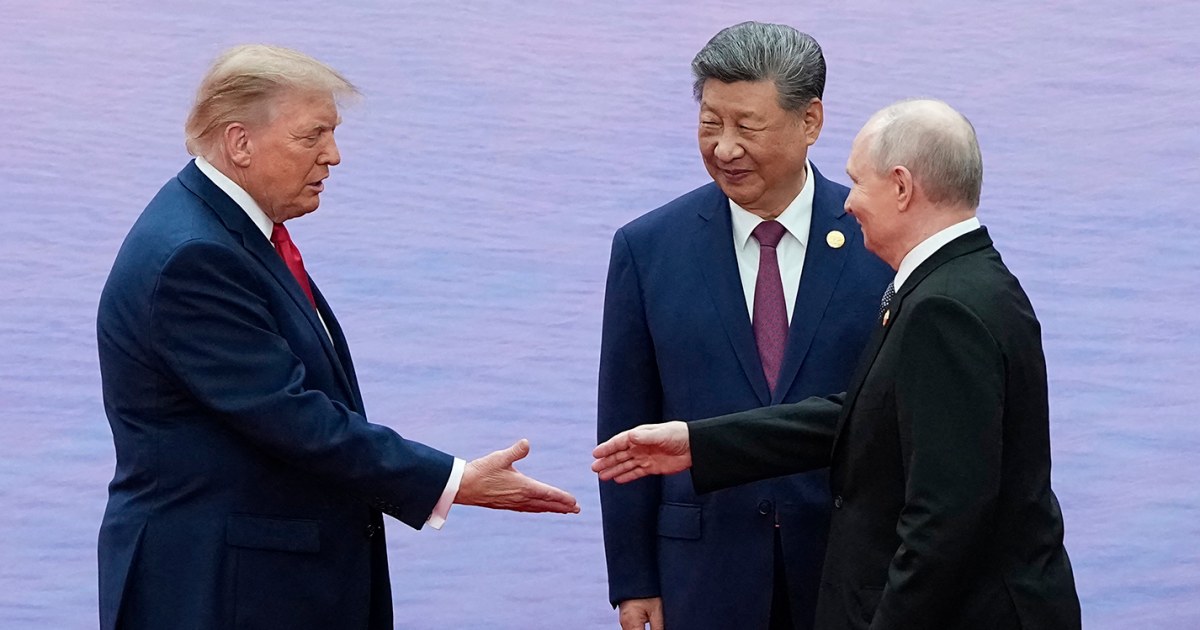
President Donald Trump, Russian President Vladimir Putin and Chinese President Xi Jinping are set to meet Thursday on the sidelines of the Asia-Pacific Economic Cooperation summit in Shenzhen, China. The gathering could carry major geopolitical significance, though analysts and officials caution that it may produce no concrete results.
The meeting marks a shift from Washington’s post-Cold War policy of driving a wedge between Moscow and Beijing, said Ali Wyne, a senior adviser for U.S.-China relations at the International Crisis Group. Trump and Putin “are currying favor with President Xi,” he said. “The symbolism is going to be very powerful.”
Trump has said he wants to discuss nuclear disarmament, the Iran war, economics and trade. On Monday, he added his “favorite subject, Ukraine,” contradicting White House officials who had said days earlier that Russia’s war would not feature in the discussions.
Trump has called for a new nuclear arms control deal involving China and Russia after New START, the last arms control deal between Washington and Moscow, lapsed in February. John B. Emerson, a former U.S. diplomat who served as ambassador to Germany under President Barack Obama, said: “When the leaders of the three largest nuclear powers sit down to discuss how to reduce the proliferation of these weapons, that is always important.”
Trump also has sought to resume talks with North Korean leader Kim Jong Un over his sanctioned nuclear program. He “sees denuclearization as a legacy deal,” said Craig Singleton, a China expert at the Foundation for Defense of Democracies. “He’s betting that his relationships can get leaders into a room that other presidents couldn’t assemble,” Singleton said in written comments.
Singleton said a bigger accomplishment would be getting Beijing to join substantive nuclear arms reduction talks, but called that possibility a “long shot.” China is reluctant to engage on the issue: its estimated arsenal of 600 warheads is growing rapidly but remains far smaller than the more than 5,000 held by each of the U.S. and Russia.
Moscow wants Ukraine on the agenda, though not at the table. U.S. and Russian officials have called for negotiations over Europe’s wider security arrangements to be part of any lasting peace settlement, a prospect that alarms long-standing American allies.
Ukrainian President Volodymyr Zelenskyy said last month: “we really don’t want this to turn into ‘Yalta 2, 3, 4’ with a redistribution of influence.” At the 1945 Yalta Conference, the major powers divided Berlin into occupied zones, sowing the seeds for communist control of Eastern Europe and the beginning of the Cold War.
Senior U.S. officials said before Trump’s trip that the Ukraine war was a separate “track” that China was not part of and that it would not be “appropriate” for the three leaders to discuss it. Beijing has also indicated it is reluctant to discuss Ukraine without European leaders present.
Even if the leaders make no decisions on Ukraine, the meeting itself reinforces Ukraine’s suspicion “that Washington is increasingly negotiating with Moscow to the detriment of Kyiv, or perhaps even siding with Moscow,” Wyne said.
China has described the trilateral meeting as having “groundbreaking significance” while seeking to manage expectations. Da Wei, director of the Center for International Security and Strategy at Tsinghua University in Beijing, said he did not expect concrete results, but called the meeting a “starting point” that could promote international stability.
“No matter we like them or not, these three leaders and these three countries are major shapers of the international order,” Da said in an interview Wednesday. “So for that reason, I think the meeting among the three is a good thing.”