Finnish satellite developer ICEYE has made an all-cash voluntary tender offer to buy Italian rocket-maker Avio for more than $2.2 billion, proposing to create what it described as Europe’s first true vertically integrated end-to-end space company.
The offer was made through an Italian ICEYE subsidiary to Avio shareholders, led by Italian defense conglomerate Leonardo. Avio said its board of directors “has taken note of the notice” and is considering the offer.
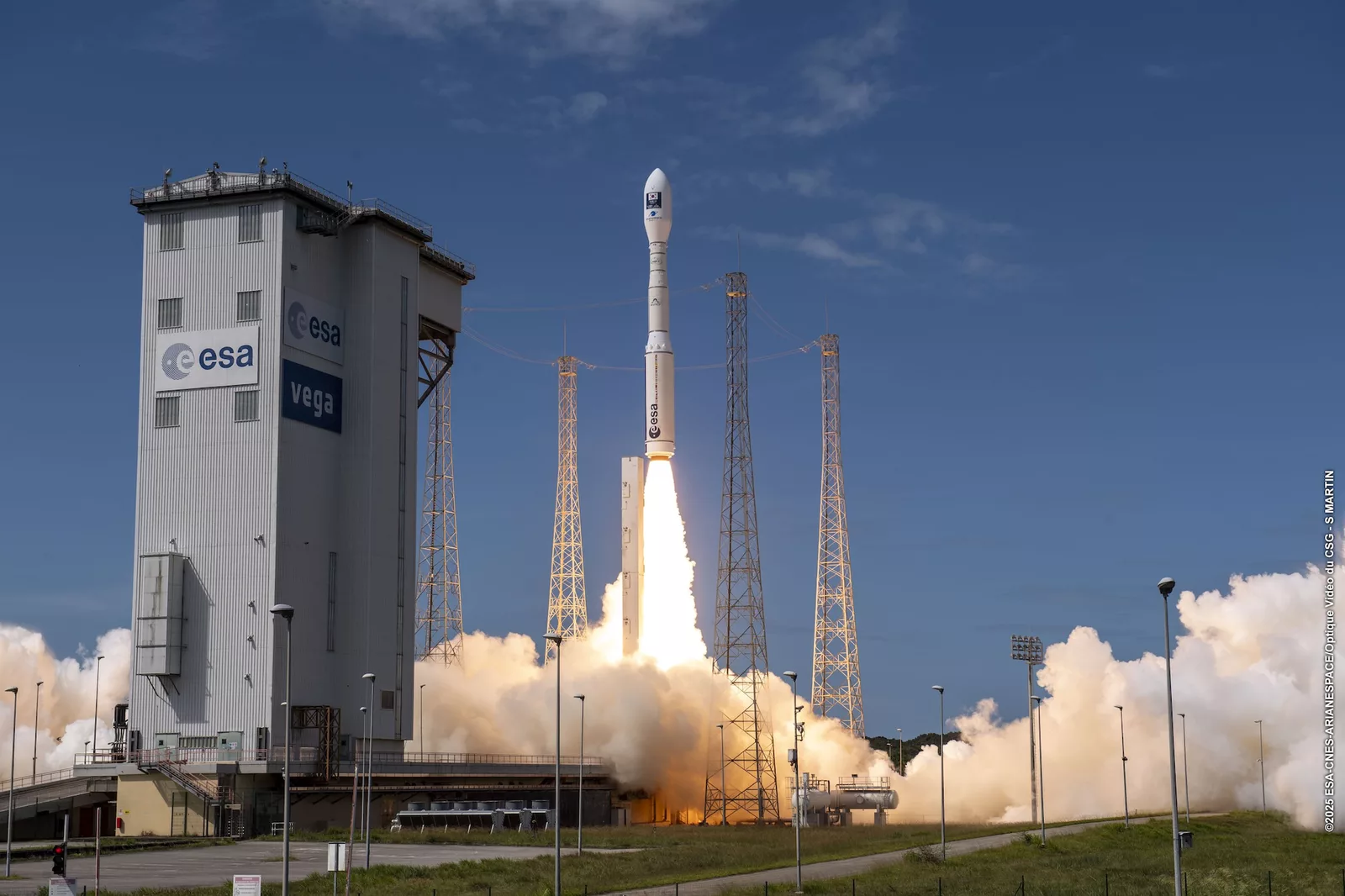
Avio builds the Vega C, a solid-fueled rocket designed to carry up to 3.3 metric tons (7,300 pounds) of payload to low-Earth orbit. The rocket has flown successfully seven times in eight attempts since 2022. Its predecessor recorded 20 successful flights in 22 attempts after debuting in 2012.
ICEYE said the proposed combination would help meet Europe’s need for “sovereign space and defense capabilities.” The company builds and operates radar-surveillance satellites and sells data to commercial customers and governments, including Ukraine, which uses ICEYE imagery to target and track Russian troop movements.
“Governments need control of their critical space infrastructure, and Europe needs it most,” said Rafal Modrzewski, CEO and co-founder of ICEYE. “Avio has built the launch and propulsion capability Europe relies on. With ICEYE’s long-term capital behind it, we can integrate the supply chain, grow output and strengthen the European programs that already depend on it. Together we can build, launch and operate sovereign space systems end-to-end, made in Europe for governments across the world.”
Avio oversees the European company consortium that produces Vega C and carries out final assembly of its rocket stages at a factory near Rome. It recently took over marketing, sales and launch-day operations from French launch provider Arianespace, bringing the Vega C operation in-house.
ICEYE has built and launched 84 radar reconnaissance satellites, which provide imagery of locations worldwide in darkness and through cloud cover. It has also sold turnkey satellites to Finland, Poland, Germany, Sweden, Portugal, Greece and the Netherlands.
ICEYE was valued at more than $12 billion after its most recent fundraising round in June. A recent report from the Organization for Economic Cooperation and Development described it as, by far, Europe’s most successful space startup, while noting that limited access to private capital, regulatory barriers and fragmented markets often hinder startup growth.
Last month, ICEYE announced a partnership with Finnish company Nokia to develop a low-Earth orbit satellite constellation aimed at European connectivity needs, particularly in defense and security. Ukraine’s Ministry of Defense announced a preliminary agreement, saying it intends to work with the companies on the constellation. The announcement came days after Ukraine reported new restrictions on access to SpaceX’s Starlink and Starshield broadband services.
“Modern warfare has proven that reliable communications are a matter of national security,” Ukrainian President Volodymyr Zelenskyy said. “We must all rely on capabilities that we can control.”
ICEYE and Nokia aim to begin launching 50 satellites a year from 2028, though they have not disclosed expected network throughput, latency or the total number of satellites needed for global or regional coverage. Depending on altitude, such coverage would likely require hundreds or thousands of satellites. SpaceX has more than 11,000 operating satellites in Starlink.
ICEYE’s future radar and broadband satellites will need launch services, while Avio needs more business for Vega C. The European Space Agency is the rocket’s primary customer, and much of the remaining schedule is filled with satellites for European governments. Its purely commercial business is limited.
ICEYE says the proposed deal would secure greater access to launch services, while Avio would receive investment to increase production and fly the Vega rocket family more frequently. The family averages fewer than three launches per year.
A dedicated Vega C launch sells for approximately $55 million, according to the most recent data cited in the article, just below the commercial price of a more powerful dedicated SpaceX Falcon 9 launch. Nearly all ICEYE satellites, apart from its first view demo spacecraft, have flown on Falcon 9 rideshare missions. SpaceX intends to phase out those missions after 2028, and sold rideshare slots for satellites of ICEYE’s size and mass for about $700,000. After accounting for potential savings from the proposed purchase, an ICEYE satellite might be able to launch on Vega C for two to three times that price.
Avio and the European Space Agency are jointly funding Vega E, a new version of the rocket that replaces Vega C’s upper section with a higher-performing methane-fueled stage. ESA and Avio also signed a nearly $50 million contract last year to begin designing a reusable upper stage, similar in concept and appearance to SpaceX’s Starship but much smaller. The early design work is intended to explore it as a potential replacement for Vega E.
The article notes that combining launch and satellite services has benefited companies including SpaceX and Rocket Lab. SpaceX’s Starlink network and Falcon 9 rocket have supported one another, while Rocket Lab expanded into satellite manufacturing after establishing the reliability of its Electron rocket. It says nearly every US launch provider, except United Launch Alliance, has a role in satellite production or in-space services, or plans to.
SpaceX’s plans to retire Falcon 9 have heightened concerns about assured access to space. The company is prioritizing Starship launches for its Starlink network and future Starmind AI satellites.
AST SpaceMobile, a competitor in satellite broadband, announced last week that it is developing a rocket for its communications network; most of its satellites so far have launched on Falcon 9. Cowboy Space, which plans to put data centers in orbit and compete with SpaceX’s Starmind initiative, has also announced plans to develop its own rocket.
The article cautions that AST SpaceMobile and Cowboy Space have no rocket-development experience and are targeting first flights in 2028, a timeline it calls “a bewilderingly fast path to the launch pad.” It also notes reasons for skepticism about ICEYE and Avio, while saying a combined company would have established satellite and rocket production lines and backing from European governments seeking to reclaim sovereignty amid fraying ties with the United States.