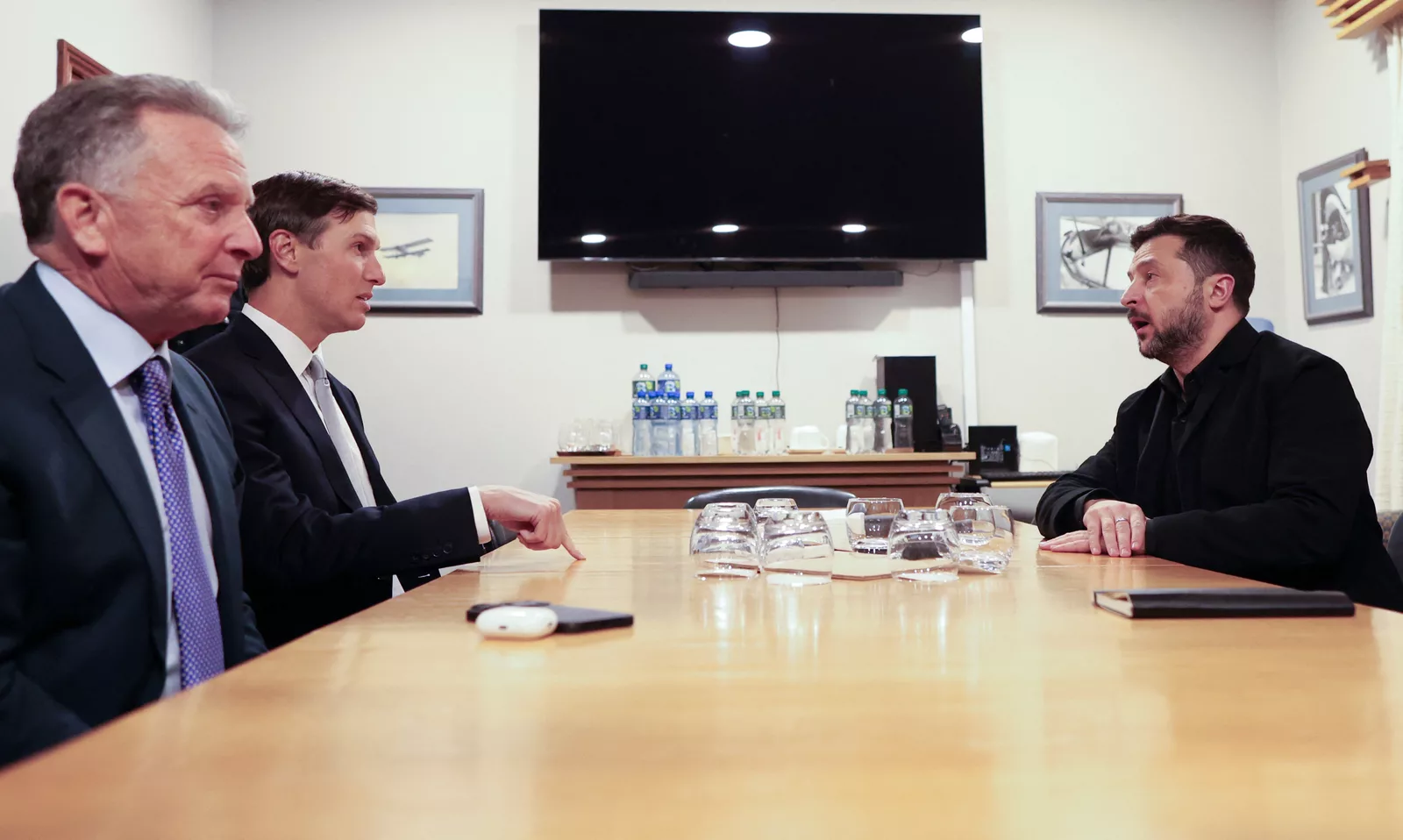
The Briefing: Ukrainian President Volodymyr Zelensky confirmed Thursday that the European Union will participate directly in the next round of Ukraine-Russia peace negotiations — not as observers on the margins, but as part of the negotiating team.
The announcement followed a late-night meeting at Dublin's Casement Aerodrome between Zelensky and Trump envoys Jared Kushner and Steve Witkoff, who had spent the morning briefing Vladimir Putin at the Kremlin. Zelensky also confirmed a major prisoner-of-war exchange — one of the largest since the full-scale invasion began — crediting American mediators for brokering the deal.
Ukrainian President Volodymyr Zelensky marked a significant diplomatic shift on Thursday, confirming that the European Union will join the next round of Ukraine-Russia peace negotiations as a direct participant — not a sideline observer — after an evening meeting at a military airbase outside Dublin with the Trump administration's two lead mediators.A Seat at the Table, Not in the HallwaySpeaking to reporters at
Casement Aerodrome in Baldonnel, Zelensky said the American side had moved to secure Europe's formal inclusion ahead of the upcoming negotiations.
"The American side made advances so that Europeans in the next meeting can be part of the negotiating team," he said, stressing that this meant a genuine place at the table — "not on the margins, not separately."For Kyiv, the distinction carries real weight.
Ukraine holds formal EU candidate status, and Zelensky has long argued that any durable postwar security arrangement must involve Brussels as a principal — not an afterthought. The European Commission and Council had already sent senior representatives to the previous Abu Dhabi round, though Russia had refused to include them in the main trilateral session.
Thursday's development signals that resistance may be softening.Kushner Pushes for European Inclusion — Putin Gives It a TryJared Kushner, speaking alongside Zelensky, was direct: a peace agreement for Ukraine cannot hold without European governments formally engaged. He said Putin had taken on board the argument for European delegates to have a place at the table.
"He's willing to give it a try," Kushner said — a marked shift from Moscow's earlier position, which had explicitly excluded European delegations from the Abu Dhabi talks.Kushner also pointed to what he described as "close work" with European governments and institutions over recent months, and indicated that Washington actively supports a broader European role in the process going forward.
He did, however, express frustration at the appearance of a divided European front, suggesting the bloc's credibility at the table depends on its ability to arrive with a unified position.From the Kremlin to Dublin in a Single DayThe Dublin stop capped a full diplomatic day for the two envoys.
Earlier Thursday, Witkoff and Kushner had spent roughly two and a half hours at the Kremlin, briefing Putin on the outcomes of the latest Abu Dhabi talks — the first Russia-Ukraine negotiating session in nine months, held November 10-11.
Witkoff had said after those sessions that gaps between the parties had narrowed, though the two sides remain far apart on the fundamental questions of territory and security guarantees.Putin, for his part, reportedly asked Witkoff and Kushner to thank President Trump for arranging the Abu Dhabi talks — the first trilateral negotiations since February 2026.
Putin has stated he is not seeking a frozen conflict but rather a settlement with clearly defined borders.One of the War's Largest Prisoner ExchangesBeyond the structural breakthrough on EU participation, Zelensky confirmed that the latest round of diplomatic contacts had also produced a concrete humanitarian result: a prisoner-of-war exchange described as one of the largest of the entire war.
During the Abu Dhabi negotiations, both delegations had discussed a potential swap on the scale of 1,000-for-1,000 or even 1,500-for-1,500 prisoners."This is a real result, it is very important, a success," Zelensky said, attributing the agreement to American mediation efforts.Dublin as a Stage: The EU Figures Out Who Speaks for EuropeThe choice of Dublin was not coincidental.
Ireland is home to more than 100,000 Ukrainians who fled the war, and Zelensky was in the country for his first official visit, meeting Irish political leaders and participating in the ninth gathering of the European Political Community.
An informal EU summit was scheduled for Friday — with all 27 member states set to coordinate a unified position ahead of any future peace contacts.The gathering had been preceded by an urgent push from Italian Prime Minister Giorgia Meloni, who had sent a formal letter to European Council President António Costa warning of "disarray" in EU diplomatic formats and calling for a designated European envoy for the peace
process.
Costa backed the concern publicly, writing that "the European Union's participation must be organized in a manner that enables it to convey a clear and unified message."Whether Friday's Dublin summit produces that institutional clarity — a named envoy, a formal mandate — remains to be settled.
But Thursday's confirmation that the EU will occupy a chair at the next negotiating table, rather than await its outcome from the corridor, represents the most concrete step yet toward the kind of European inclusion Kyiv has demanded since peace talks first began to take shape.