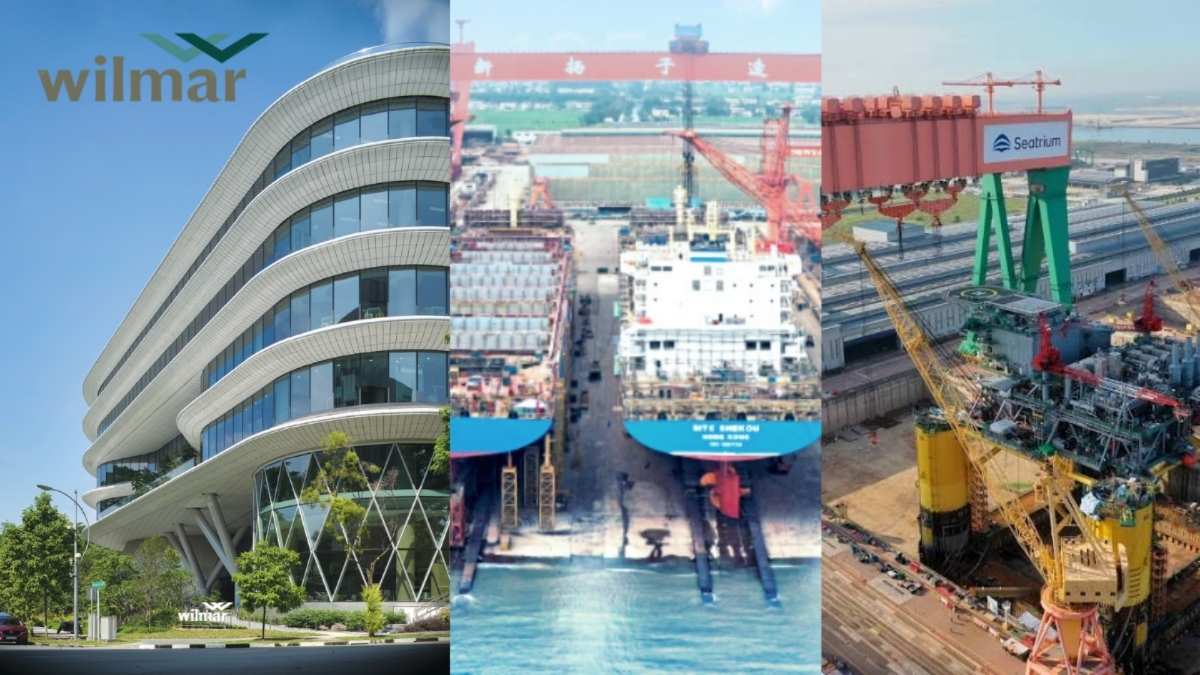
The Straits Times Index (STI) declined 5.1% in October 2026, with Wilmar International, Yangzijiang Shipbuilding and Seatrium recording even sharper falls. We look at what has changed for these three Singapore blue chips, and whether their lower share prices warrant a closer look.
Singapore blue chip stocks fell in October.
The Straits Times Index (STI) ended October 2026 5.1% lower, with several index constituents recording double-digit share-price declines.
Wilmar International was the worst performer, falling 16.6%, followed by Yangzijiang Shipbuilding at 11.3% and Seatrium at 10.7%, according to FactSet.
Interestingly, Yangzijiang Shipbuilding was the best-performing Singapore blue chip in September, before reversing course in October.
We also previously looked at Singapore blue chip stocks trading near their 52-week lows, including Seatrium.
With these share-price declines, I wanted to find out whether the three Singapore blue chips are worth revisiting, or whether their fundamentals suggest more caution is warranted.
Wilmar International was the worst-performing Singapore blue chip in October, with its share price falling 16.6%.
Wilmar is one of Asia's largest agribusiness groups, with operations spanning oil palm plantations, oilseed crushing, edible oils, food products and sugar.
Its latest third-quarter results provide some context for the weakness in its share price.
Wilmar reported revenue of US$21.66 billion for the third quarter of 2026 (3Q26), an increase of 13.6% year on year.
However, core net profit fell 25.2% year on year to US$267.3 million.
The decline reflected higher raw material costs in its food products business and weaker soybean crushing margins.
This suggests that higher sales are not necessarily translating into stronger profitability across Wilmar's businesses.
For investors, the more important question is whether these margin pressures are temporary or could continue into subsequent quarters.
If raw material costs remain elevated and Wilmar is unable to pass them on to customers, its earnings could remain under pressure.
Another development in October was the disclosure of preliminary inquiries by Indonesian police into fires affecting land associated with Wilmar's subsidiaries in West Kalimantan.
The development has added regulatory and reputational uncertainty for the company.
Wilmar passes two of the three fundamental checks.
It passes the revenue and earnings check, with earnings per share (EPS) growth of 20.9% outpacing revenue growth of 4.5%.
Wilmar also passes the valuation check. Its price-to-earnings (P/E) ratio of 10.3 times and price-to-book (P/B) ratio of 0.66 times are below their historical averages, while its forward dividend yield of 5.0% is above its historical average.
However, Wilmar is flagged on balance sheet strength, with a net debt-to-equity ratio of 129.1%, above the screener's 100% threshold.
While Wilmar's valuation appears relatively attractive against its historical averages, its higher leverage and recent earnings pressure warrant caution.
Wilmar's share-price decline may warrant a closer look, but the earnings outlook remains an important consideration.
I would focus on whether its food products margins recover, whether soybean crushing profitability improves, and whether cash generation remains healthy.
I would also monitor developments relating to the Indonesian fire inquiries.
Yangzijiang Shipbuilding was the second-worst-performing Singapore…