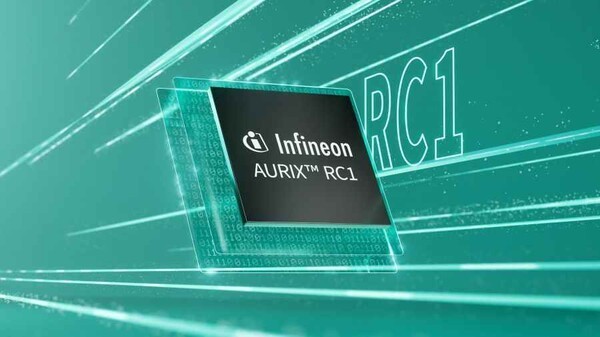
Germany's Infineon unveiled AURIX RC1, its next-generation RISC-V-based automotive microcontroller (MCU) platform, on Nov. 10. The product family supports up to 12 32-bit processor cores and 40MB of embedded memory. The company plans to begin supplying samples in the first half of next year.
The announcement provides further details on Infineon's plans to develop RISC-V automotive MCUs, which the company outlined at a press conference in South Korea in April.
Infineon currently offers automotive MCU families including its proprietary TriCore-based AURIX and Arm-based TRAVEO T2G. AURIX is used in applications requiring high levels of real-time control and functional safety, such as powertrains and chassis systems, while TRAVEO T2G serves applications including body control and displays.
Unlike these existing product families, AURIX RC1 is designed around the RISC-V architecture. Infineon said it combines the real-time control capabilities and functional safety of AURIX with the strengths of TRAVEO T2G.
The platform can be used in software-defined vehicles (SDVs) and physical artificial intelligence (AI) applications, including zone controllers, body and chassis control, battery management systems, powertrains, safety management for advanced driver assistance systems (ADAS), and cockpits.
Conventional vehicles distribute multiple electronic control units (ECUs) across individual functions, while SDVs increasingly consolidate these functions into central vehicle computers and zone controllers. This shift requires individual MCUs to deliver greater computing performance and high-speed communication capabilities.
Infineon said it will use RISC-V's modular architecture to optimize computing performance and power consumption for different applications while providing a common software development foundation.
AURIX RC1 also supports parallel processing units for edge AI computing. Infineon plans to expand the RC1 family with products incorporating 64-bit microprocessor (MPU) capabilities, extending the portfolio into high-performance computing applications.
Infineon has also enhanced in-vehicle communication capabilities. The platform supports communication standards including CAN-XL, 10BASE-T1S and multi-Gigabit Ethernet. Selected products integrate Infineon's BRIGHTLANE Ethernet switching technology and hardware-based data routing.
The platform is designed to support applications up to Automotive Safety Integrity Level D (ASIL D), the highest automotive functional safety classification. For cybersecurity, it incorporates security features addressing standards and regulations including ISO/SAE 21434 and the European Cyber Resilience Act (CRA).
Infineon said the platform is also designed to accommodate emerging security requirements, including post-quantum cryptography (PQC).
Infineon will also provide DRIVECORE, its software development ecosystem. It supports the migration of software developed for existing AURIX and TRAVEO T2G products to the new RISC-V-based platform. The company said it will also offer virtual prototyping capabilities that allow developers to develop and validate software before physical chips become available, along with AI-assisted software migration tools.
"AURIX RC1 combines the flexibility of the open-standard RISC-V architecture with Infineon's expertise in reliably executing safety-critical tasks in real time," said Peter Schiefer, president of Infineon's Automotive Division.