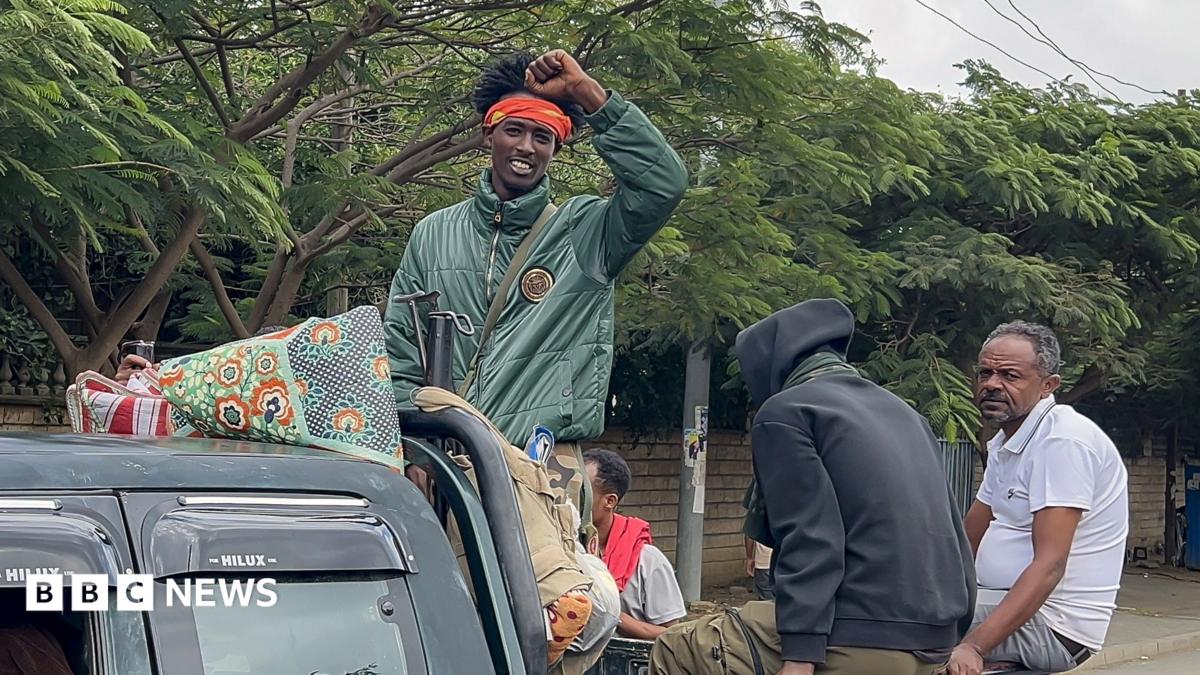
Pro-government forces marched into Tigray's capital less than two weeks after the war began
Running a hair salon in Mekelle, capital of Ethiopia's troubled northern Tigray region, is not easy at the moment.
"People can't prioritise beauty over daily basic needs. For many residents, thinking about self-care is a luxury, at a time when they can't feed their kids," Firut Me'ar, who runs a salon in the city, tells the BBC.
After a brief war, the city is under the control of the national army but life is far from normal, says Firut, a single mother of a 10-year-old daughter.
"Things are better than during the war, but people still have no money, no morale. Business is almost non-existent," she says, her voice shaking with emotion.
Above all, she says people are worried about what the future holds. "There is uncertainty about what comes next."
Fighting broke out in late September between the Tigray People's Liberation Front (TPLF), the party that had run Tigray for decades, and the national army - a resumption of the two-year civil war that officially ended in 2022.
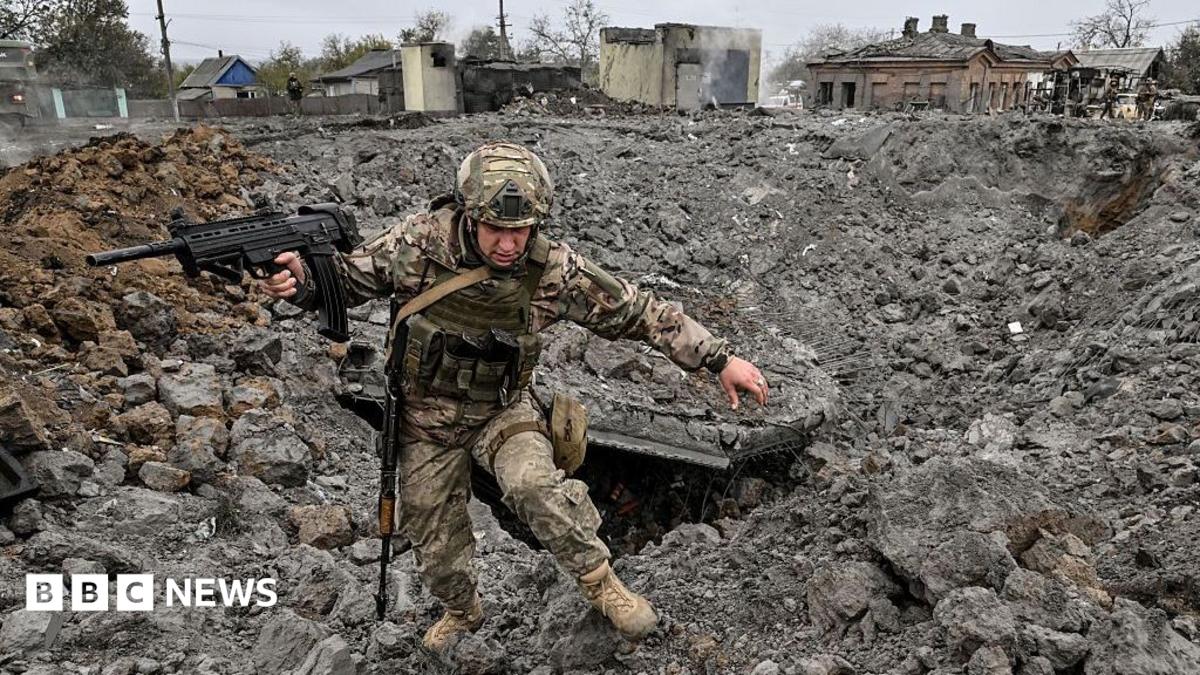
But within less than two weeks, federal forces marched triumphantly into Mekelle. The TPLF made what it called a "strategic withdrawal" from the city and Tigray's other main towns so the army encountered little resistance. Hundreds of people are reported to have died in the conflict, including dozens killed by drone strikes and bombing raids by the air force.
Ethiopian government officials and supporters argue that the war is effectively over and that the only remaining task is to clear Tigray of TPLF elements.
Getachew Reda, a senior TPLF official who switched sides and is now an adviser to the prime minister, declared that the war in Tigray had ended and that stabilising the region should now be the immediate priority.
Cameroon Hudson, an analyst and consultant on African peace and security, says there are various reasons for the TPLF's rapid defeat.
"The TPLF has lost popular support at home. It is fragmented, it does not possess the advanced military technology necessary to match the ENDF [Ethiopian National Defence Forces]," he says. "It has lost many of its generals, strategic thinkers, finest diplomats and fighters, either through defections or arrests. The infighting within the TPLF leadership has caused significant damage."
Abraha Hailezgi, a scholar at Mekelle University, agrees. "The army lacks a clear political vision. In recent years, it has become associated with coercion, abuses, forced recruitment and arbitrary actions. As a result, many people have come to view the TPLF army as an adversary rather than a force acting on their behalf," he says.
Speaking by telephone from an undisclosed location, TPLF spokesperson Mikael Asgedom denies that the group has lost.
Instead, he describes it as a deliberate tactical and strategic retreat. "This is not a defeat," he tells the BBC.
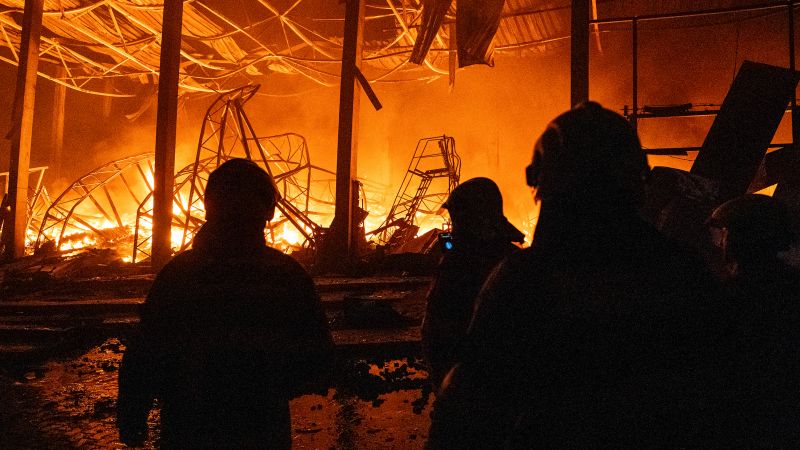
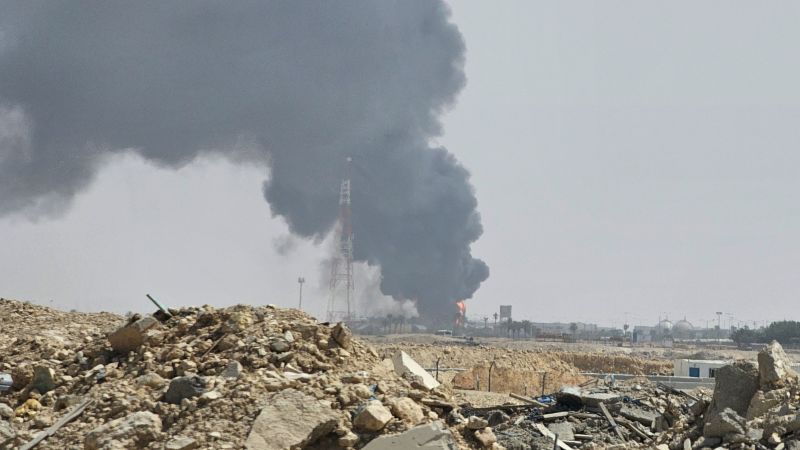
Dozens of people were killed in drone strikes during the short conflict
He says the TPLF "intentionally allowed the ENDF to advance deeper into the heartland of Tigray", where it can be isolated and confronted on favourable terrain. "We chose not to fight on terms favourable to the enemy."
The TPLF is preparing for a major counteroffensive, he says, adding that TPLF fighters have launched attacks against Ethiopian forces in several locations following their withdrawal from the region's towns, arguing that these operations demonstrated the group's continued military capability.
It is hard to get verified information from Tigray and the BBC is unable to report from there. But phone lines and the internet, which were cut when fighting broke out, have now been restored.
Residents in different parts of Tigray tell the BBC that fighting is continuing in central, northern and north-western parts of Tigray, with the use of heavy artillery and drone strikes.
Eyewitnesses around Sheraro, a town near the Eritrean border, report heavy fighting involving artillery and ground forces in recent days.
"We could hear heavy artillery fire from the Sheraro direction. People are concerned because there is no sense of security," a businessman tells the BBC on condition of anonymity. He adds that military convoys from both sides had moved towards Sheraro, while a motorcycle operator in the southern town of Yechila says military checkpoints are still active.
Memories of the devastating 2020-2022 Tigray war remain raw for many residents.
The conflict saw widespread human rights abuses and allegations of ethnic cleansing in Western Tigray, while estimates suggest the war claimed hundreds of thousands of lives.
As soldiers from Eritrea, accused of some of the worst atrocities in the previous conflict, and Ethiopia have reappeared in Tigray's towns, many residents describe a profound sense of fear and anxiety, saying the sight of the troops has reopened still-fresh wounds.
Military sources aligned with the federal army say operations against the TPLF are continuing, with recent fighting and troop movements reported in northern Tigray, near the Eritrean border, as well as across central Tigray's rugged highlands. They claim the TPLF's capabilities are being steadily degraded.
Security analysts and observers agree that unrest is likely to continue for some time. "I see a situation in which there could be a prolonged war in Tigray," Yared Tibebu, a well-known Ethiopian commentator based in the US, tells the BBC.
Yared argues that the TPLF has a long history of waging protracted armed struggles and believes the movement is once again preparing for a lengthy conflict. He believes that once the group has reorganised its military and political structures, it may attempt to resume offensive operations.
However he believes this will not happen for some time because of internal divisions - a suggestion dismissed by TPLF spokesperson Mikael.
The army says it seized all these weapons from the TPLF during the fighting
Hudson rejects the idea that Tigray is heading towards a prolonged war but agrees that the region may not be truly peaceful for some time. "The TPLF may continue a low-level insurgency and guerrilla campaign, but that is not war. I do not think there will be a wider-scale conflict between the federal forces and the TPLF."
He says the TPLF no longer possesses the size, strength or military capability required to effectively confront federal forces, which he says have significantly expanded and modernised in recent years. "The TPLF has also lost much of its public support and cannot easily rebuild its ranks through recruitment," he says.
Yared, on the other hand, points to the TPLF's history of overcoming setbacks as evidence that the movement could recover to sustain a prolonged struggle. "The TPLF has overcome many major challenges in the past. It is wrong to conclude that it has no public support. It is a political movement with a history stretching back more than 50 years," he says.
Most Mekelle residents only have money for the basic necessities at the moment
What Yared sees as a strength, Hudson sees as a weakness, saying the TPLF is still "trapped in the past", and continues to behave as a dominant party within Tigray, even though the situation has changed. "It is a movement that has not evolved, modernised or expanded."
While Hudson argues that the TPLF is not equipped to sustain a major military campaign, the TPLF spokesman says the group obtains weapons and logistical supplies from the Ethiopian military. "We seize weapons from our enemy, and the weaponry that has entered Tigray will, sooner or later, become ours."
In early October, eyewitnesses told the BBC they had seen Eritrean troops in Tigray amid reports they were backing the TPLF. However, they appear to have returned home and Hudson thinks the country would be wary of becoming further embroiled in the conflict.
"First, Eritrea does not have unlimited resources. Second, the TPLF is no more an effective military force, and Eritrean leaders may have concluded that supporting it at this stage would not yield significant military gains," he says. "Third, Eritrea would have to consider the risk of provoking a confrontation with Ethiopia if it openly backs the TPLF."
Sources in the Ethiopia army tell the BBC that senior members of the TPLF's political leadership were briefly based in Eritrea, however, they say the authorities ordered them to leave in early November, shortly after President Isaias Afwerki returned from Russia. According to the sources, the move was driven by concerns that Ethiopia could use their presence as a reason to invade.
Hudson also argues that Eritrea's renewed diplomatic engagement with the US, whose relations with the TPLF have long been strained, could further discourage Asmara from providing meaningful support to the movement.
In September, seven Ethiopian rebel groups led by the TPLF announced the formation of a new coalition called the Alliance for Survival, aimed at removing Prime Minister Abiy Ahmed's government.
Seven rebel groups from across Ethiopia have announced a new alliance
Yared believes the alliance could give the TPLF the strength to keep on fighting. "Its members can combine their strengths. The TDF [the TPLF's military wing] has leadership experience and organisational capacity, while Fano [an ethnic Amhara militia] is believed to have between 70,000 and 80,000 fighters.
"If conditions emerge that allow the forces to co-ordinate effectively, the TPLF's current difficulties may not last long," he says.
Hudson, however, rejects that argument, insisting that the alliance is unlikely to alter the balance of power. "I don't think the TPLF can be saved by this alliance. The ethnic militias have not demonstrated the capacity, either individually or collectively, to pose a serious threat to federal forces. We should not underestimate the strength of the federal army," he says.
Abraha from Mekelle University argues that the conflict in Tigray will only truly be over if the federal government addresses the region's feeling that it has been marginalised, both economically and politically by the current government.
However, many Tigrayan elites and political observers remain wary of the federal government's intentions. They question whether the authorities in Addis Ababa are genuinely seeking to address Tigray's problems, or whether they are taking advantage of the region's weakness to boost their influence.
In the meantime, many ordinary people in Tigray say their priority is peace.
"Peace seems slow in coming. Most people are tired of politics. Whatever happens, we only want peace and a chance to rebuild our lives," says Firut from her beauty salon in Mekelle.
How fresh fighting in Tigray could spark wider conflict in Ethiopia
The young women who fought in Ethiopia's last civil war and don't want to see another one
Ethiopia PM's party wins landslide as fears grow of new conflict
Go to BBCAfrica.com, external for more news from the African continent.
Follow us on Twitter @BBCAfrica, external, on Facebook at BBC Africa, external or on Instagram at bbcafrica, external