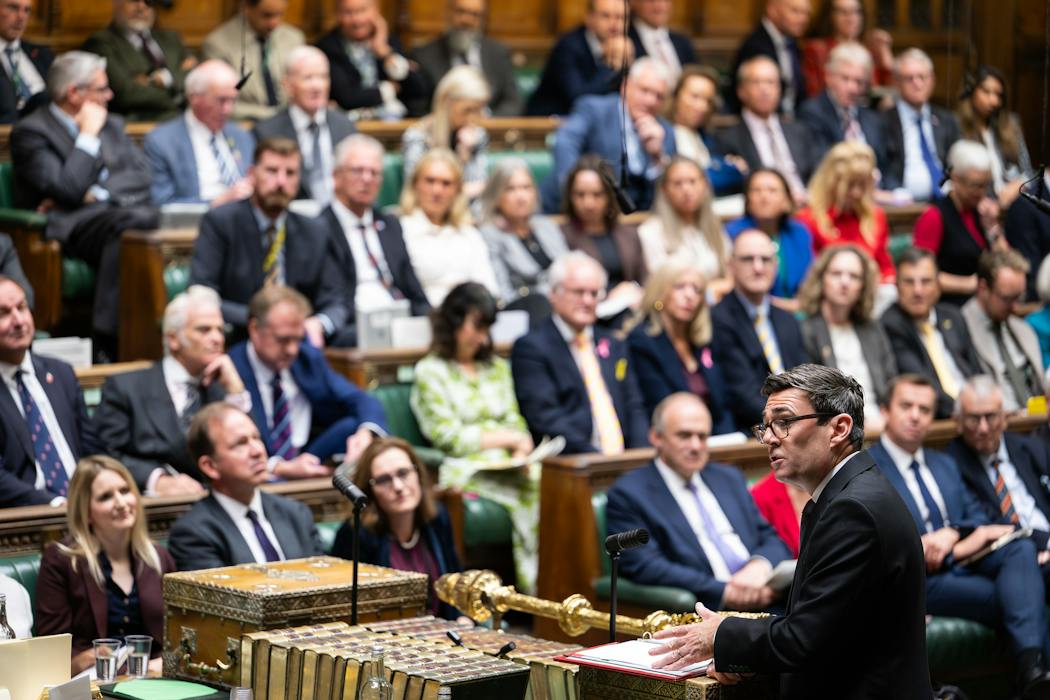
A new poll of voters in Prime Minister Andy Burnham's Makerfield constituency shows strong opposition to aligning United Kingdom policy with European Union regulations, dealing a significant political blow to the government's planned diplomatic reset with Brussels.
Since taking office, Burnham has articulated a distinct foreign policy strategy that seeks to connect international engagement with domestic economic renewal.
Central to this political approach is the self-imposed "Makerfield Test," a rhetorical and strategic benchmark requiring that government policies—particularly those concerning international treaties and trade—must deliver tangible economic benefits and remain politically acceptable to ordinary voters in his Leave-voting Greater Manchester constituency.
Cabinet minister Hamish Falconer, who is currently leading the UK-EU reset negotiations, recently confirmed that future agreements with the European Union must explicitly pass this specific test by producing concrete, everyday advantages. The government has hoped to secure mutual recognition of professional qualifications and visa-free travel for British workers in exchange for closer regulatory cooperation.
To rigorously evaluate whether the government's European strategy meets this benchmark, the cross-party campaign group Britain Unbound commissioned the polling firm Survation to survey Makerfield residents.
The survey was explicitly designed to test core democratic attitudes regarding where political decisions should be made, deliberately omitting direct mentions of the European Union or Brexit to avoid activating entrenched voting tribes.
Respondents were asked who should possess the ultimate legislative authority to decide United Kingdom economic policy across ten distinct regulatory areas, testing the limits of acceptable international alignment.
The polling results demonstrated a decisive and overwhelming preference for national sovereignty over international alignment. Across every tested issue, a clear majority of Makerfield voters stated that policy should be determined solely by the elected United Kingdom government.
The strongest opposition to international alignment concerned state aid for regional economic development, with 80 percent of respondents insisting the UK must retain complete, unencumbered control. Core taxation policy followed closely, with 78 percent stating the UK government alone should set Value Added Tax (VAT) rates.
The desire for absolute domestic control extended to border security, with 75 percent supporting unilateral authority over refusing convicted criminals entry to the country.
The survey also tested areas where the European Union frequently requires strict regulatory alignment as a fundamental condition of single market access. In Makerfield, 74 percent of voters want food standards decided exclusively in the UK parliament, while 69 percent hold the same view on agricultural animal welfare regulations.
Furthermore, 67 percent stated that the approval and regulation of medicines for the National Health Service should remain a strictly domestic competency handled by British regulators. Conversely, only between 2 percent and 12 percent of respondents believed the United Kingdom should be legally required to follow decisions made by international institutions on any of the ten issues surveyed.
The polling data presents a substantial political challenge for the Burnham administration ahead of the anticipated UK-EU policy…