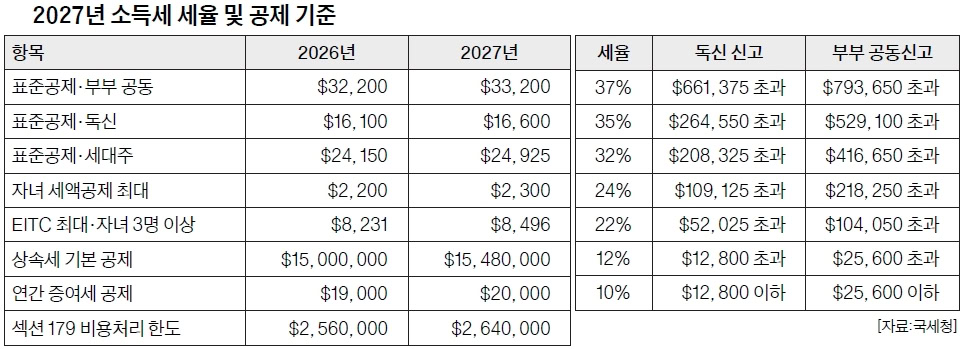
The Internal Revenue Service has announced inflation adjustments for tax year 2027, raising the standard deduction to $33,200 for married couples filing jointly and increasing the maximum child tax credit to $2,300. The changes, announced Nov. 5, cover nearly 70 tax provisions, including income tax brackets, adoption credits and business expense deductions.
They generally apply to 2027 income reported on federal tax returns filed in 2028. The standard deduction for married couples filing jointly will increase by $1,000 from 2026. Single taxpayers and married people filing separately will have a standard deduction of $16,600, while heads of household will be eligible for $24,925.
The federal income tax rates will remain unchanged, ranging from 10% to 37%, but the income thresholds for those rates will increase. The following brackets apply to taxable income, rather than total earnings before deductions.
Tax rateSingle filers: taxable incomeMarried filing jointly: taxable income10%$12,800 or less$25,600 or less12%Over $12,800 through $52,025Over $25,600 through $104,05022%Over $52,025 through $109,125Over $104,050 through $218,25024%Over $109,125 through $208,325Over $218,250 through $416,65032%Over $208,325 through $264,550Over $416,650 through $529,10035%Over $264,550 through $661,375Over $529,100 through
$793,65037%Over $661,375Over $793,650 The maximum child tax credit will rise by $100 to $2,300 for 2027.
The portion that may be refundable will also increase by $100, reaching $1,800. The maximum earned income tax credit for qualifying taxpayers with three or more qualifying children will increase to $8,496, up from $8,231 in 2026. Eligibility and credit amounts depend on income and family circumstances. For adoptions, the maximum credit will rise to $18,250 in qualified expenses, compared with $17,670 in 2026.
Up to $5,280 of the credit may be refundable in 2027. Employees who contribute to health flexible spending arrangements through payroll deductions will be able to set aside up to $3,500 in 2027, an increase of $100. Plans that allow unused funds to carry over will have a maximum carryover of $700, up $20.
The monthly limits for qualified transportation benefits and qualified parking will each rise to $350, an increase of $10 from 2026. Businesses will be able to expense up to $2.64 million in qualifying property under Section 179, up from $2.56 million. The Section 179 limit for sport utility vehicles will increase to $33,100 from $32,000.
The annual gift tax exclusion will increase to $20,000 per recipient in 2027, up from $19,000. The basic federal estate tax exclusion for people who die in 2027 will rise to $15.48 million, compared with $15 million in 2026. Not all provisions will change.
Personal exemptions will remain at zero, and the income thresholds for phasing out the Lifetime Learning Credit will remain $80,000 to $90,000 for individual filers and $160,000 to $180,000 for joint filers.