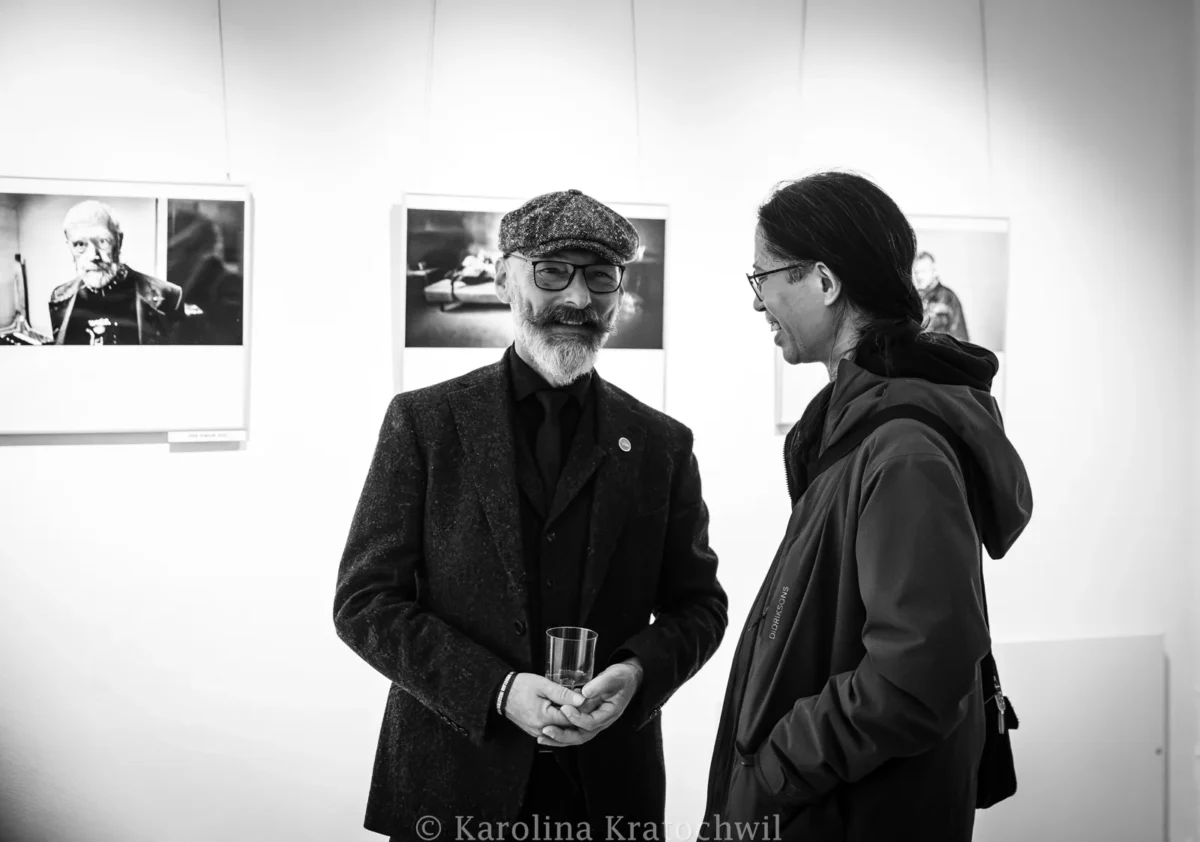
Stefan Alt’s photography exhibition “SALT.WIF” opened at Galeria ZPAF in Wrocław on 6 November, presented as part of the 25th anniversary of Wrocław Industrial Festival. It brings together images from different editions of the festival, and there is something fascinating about seeing a concert you remember through another photographer’s eyes.
You recognise the musician, perhaps even the gesture, yet the image reveals something you never noticed: a fleeting expression, an unexpected arrangement of light and shadow, a detail that escaped your attention while the music was playing. What once belonged to a familiar experience suddenly looks different.
For many visitors, these photographs offer a view of the festival’s history. For me, they also opened a rather personal conversation with the past.
Stefan Alt, who exhibits and records under the name SALT, is widely recognised as the founder of ant-zen, the German independent label established in 1993. Its catalogue has been influential in industrial, rhythmic noise and experimental electronics, but Stefan’s contribution extends well beyond the records themselves.
Photography, graphic design, typography and the physical presentation of releases have long been central to his artistic practice. With ant-zen, the visual identity has never felt like packaging added after the music was finished; it is part of how that music enters the world.
I’ve admired Stefan’s work for years. His album covers, photographic compositions, merchandise and graphic designs have a raw, instantly recognisable beauty, often achieved with remarkably little. A surface, a fragment of an object, the tension between black and white: elements that might appear unremarkable in isolation acquire force through his attention to proportion, texture and detail.
There is poetry in his restraint, and sometimes surprising tenderness in images that initially seem severe. I’ve always found that contradiction compelling.
It would be easy to associate such an aesthetic exclusively with the harsher end of industrial culture, but that would miss the curiosity behind it. Stefan does not seem interested in making images that simply look industrial. He is interested in what happens when familiar materials and forms are taken out of their usual context and allowed to suggest something less obvious.
The exhibition occupies two rooms, each revealing a different side of his photographic work.
The first is devoted mainly to black-and-white concert images. Against the gallery’s white walls, their deep contrasts immediately command attention, but their graphic strength alone isn’t what makes them interesting. Stefan knows when to let a silhouette dominate a frame, when an expression says more than an entire stage, and how darkness can contribute as much as illumination.
Light sometimes isolates a musician from the surroundings; elsewhere it reduces the figure to a form almost abstract in its simplicity.
Anyone who photographs concerts knows how little control we have over the conditions. The lighting changes without warning, movement is unpredictable, and the moment you hope to capture can disappear before you’ve raised the camera. Industrial performances add their own complications: smoke, near-darkness, unconventional staging and projections that compete with the performers for visual attention.
Stefan doesn’t try to include everything. He chooses what matters within the frame and lets the rest fall away.
I was struck by how well the…