Troubled Waters: Switch to duathlon costly for ASU as Arizona completes NCAA Women’s Triathlon threepeat
By Myles Aaron Dunson ·
Troubled Waters: Switch to duathlon costly for ASU as Arizona completes NCAA Women’s Triathlon threepeat
by Myles Aaron Dunson, Cronkite News
November 9, 2026
TEMPE – On an 81-degree day, with not a cloud in the sky, conditions were perfect for swimming on Sunday.
Anywhere other than in Tempe Town Lake.
Heavy rainfall leading up to the 2026 Women's Collegiate Triathlon National Championship in Tempe, and water released through the Salt River that feeds it during the week before the event, meant the lake’s conditions didn't meet safety standards for the race.
Not only did race officials possibly find bacteria, but the lake was also acting more like a river, as an open dam created a current.
The rain didn’t just affect the lake. It might also have washed away ASU’s chances at reclaiming the top spot in NCAA triathlon.
The Sun Devils dominated the sport, winning seven straight national championships from 2016-23, before Arizona started its three-year reign in 2024. ASU has finished second in all three of those seasons.
On Thursday night, organizers decided to turn the meet into a duathlon. Rather than the planned 750-meter swim, 20-kilometer bike leg and 5-kilometer run format of a sprint triathlon, athletes started with a 2.5-kilometer run, race the bike leg and then run the 5K.
This isn’t the first time that the championship had been altered, as the 2024 event in Clermont, Fla. was changed to a two-day event with swimming happening on a separate day due to damage caused by Hurricane Milton.
With the 2026 event, the location was set for months, road permits were already in place, and with 202 triathletes traveling from 15 schools across the country, it would have been too much to move the championships.
Based on the results, the last-minute change didn’t impact which teams finished atop the event as Arizona, Arizona State and TCU finished first, second and third respectively for the second year in a row.
Also for the second year in a row, Arizona’s Kelly Wetteland led the Wildcats, capturing her second consecutive individual championship with a time of 1:00:43.7. But the swim cancellation could have affected the order the teams finished.
ASU is a team that is strong in the water. The Wildcats thrive on the run.
“The duathlon part worked for us really well,” Wetteland told the crowd in an interview with the race announcers at the finish. “We just played to our strengths.”
Arizona coach Wes Johnson echoed his star fifth-year senior, noting that the Wildcats’ run game has never been better.
“When it switched to duathlon, we weren’t fazed,” Johnson said. “We knew we could show up just as well as triathlon, and we did. That’s what is so fulfilling at the end. All the work we put in, day in, day out – the trials, the struggles – that it all comes together on the right day, and that’s our goal.”
The switch to duathlon might have worked out well for the Wildcats, as Wetteland suggested, but it didn’t work out so well for their in-state rivals.
ASU coach Cliff English said that this year’s team had done really well in the water, and anticipated that it would be a strength again for the top-ranked Sun Devils.
Even though, in his words, the Sun Devils would have loved to swim, he didn’t use the last-minute change as a crutch.
“It was the same for everyone,” English said. “We told them, and some of them woke up to the news. It changed a little bit of the taper…you just kind of do the best you can and make sure you get the team prepared and have a positive mindset.”
The lake’s poor quality didn’t just tamper with the swimming portion of the race; it had a ripple effect that trickled down into the bike leg and second run as well.
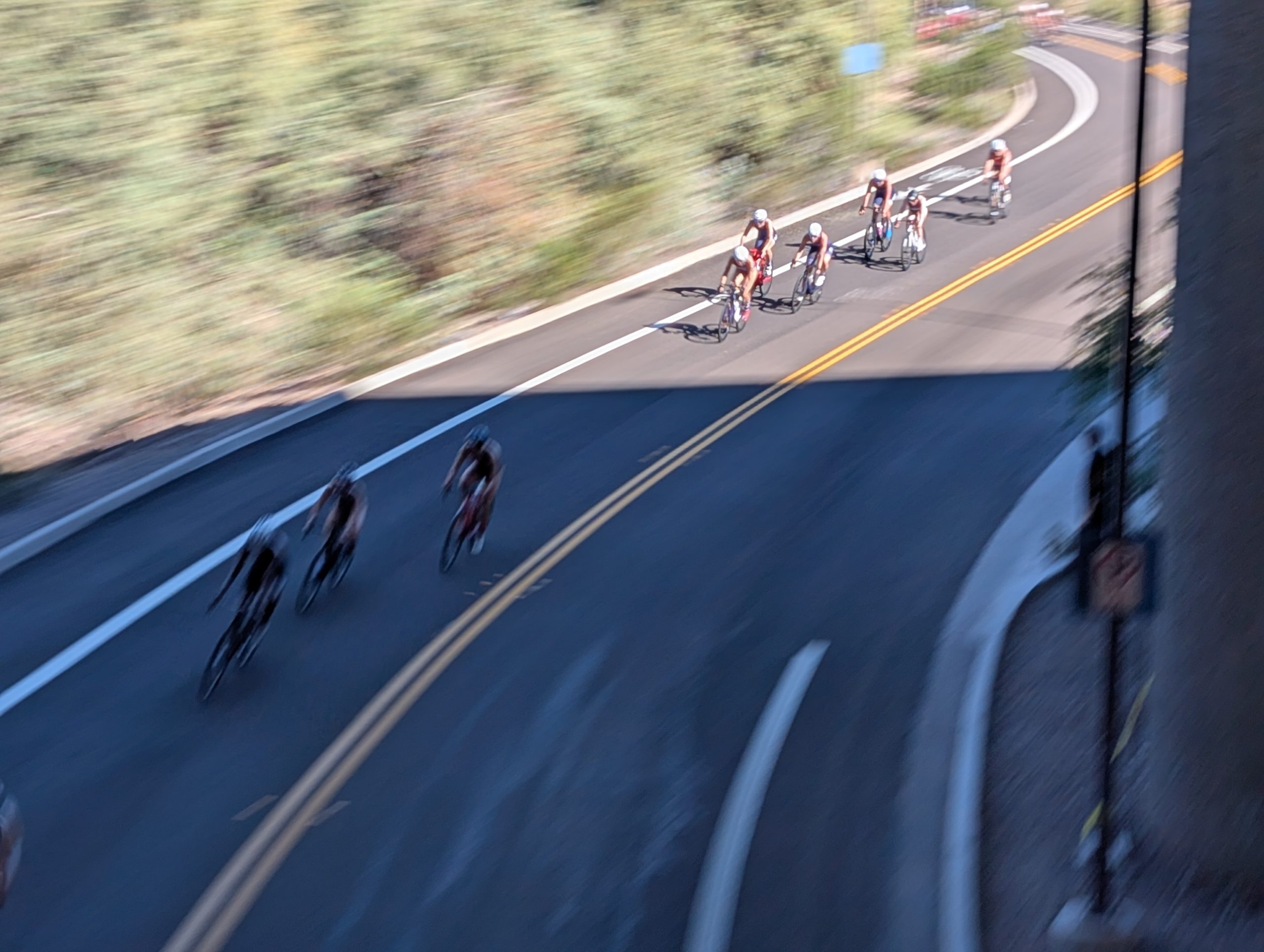
Announcers continuously told the crowd that there were large packs of racers deep into the contest, which typically thin out due to attrition as the race unfolds. Without the swim, contestants that were better runners or bikers stayed in the race longer than usual, making for a more chaotic feel than usual.
ASU’s top performer, Sidney Clement, who finished fifth with a time of 1:01:28.7, said that positioning in the bike crowds was paramount to her success – and safety.
“I think it was just really important,” Clement said. “Once I was caught at the back of the pack and through a few corners, it can really spread out. You can be in the front pack, but the leaders are 300 meters ahead of you, so it’s just really important to stand your ground.”
While the senior didn’t earn gold in her final collegiate championship, Clement and her teammates Zoe Mari Adam and Brooke Rousselle, who finished eighth and 10th, helped lead ASU to the program’s 10th consecutive top-two finish in a national championship race. There was no national meet in 2020 due to the COVID-19 pandemic.
Racing beside her teammates, just 100 meters from where she lives, with her family and friends cheering her on, Clement reminisced about her time as a collegiate triathlete.
“There’s so many good lessons to learn from NCAA triathlon,” Clement said. “Racing as a team. I hope to be a part of a lot of international relays in the future. Even just the individual racing, there’s always going to be a teammate out there, so just really racing for your teammates.
“So exciting for the future, and I’m really excited to keep following NCAA triathlon.”
This article first appeared on Cronkite News and is republished here under a Creative Commons Attribution-NoDerivatives 4.0 International License.
Originally published by Cronkite News Sports